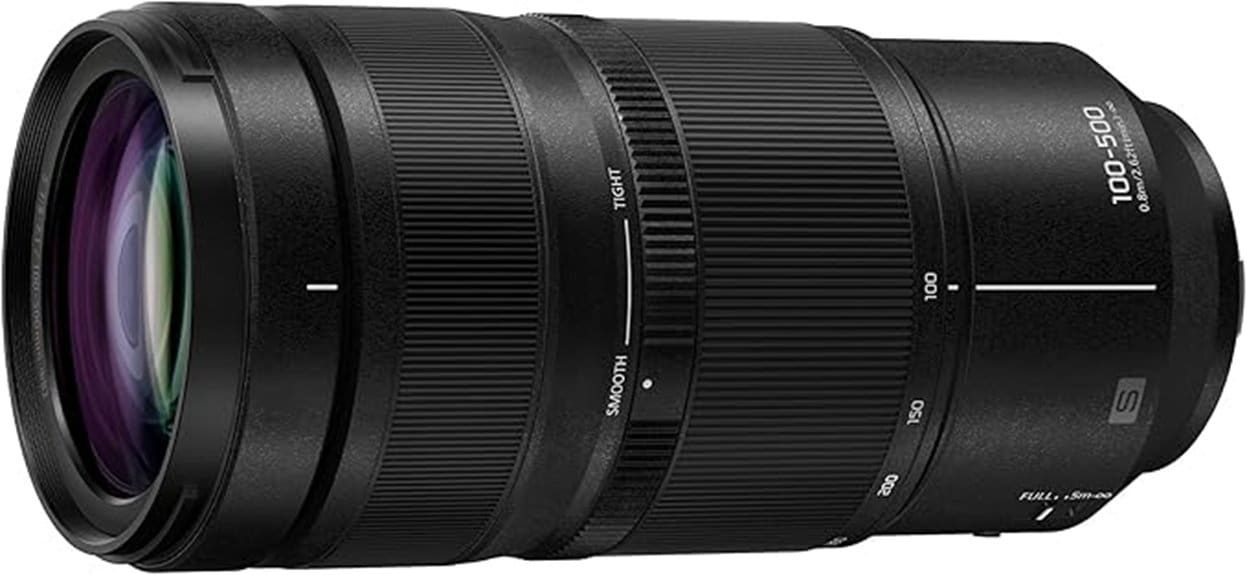
You’ll get a lightweight, weather‑sealed 100–500mm that’s consistently sharp at 500mm, preserves contrast and micro‑detail, and renders smooth, natural bokeh with strong long‑end compression. Dual Phase Linear Motors and Dual I.S. give fast, near‑silent AF and up to seven stops of stabilization for handheld telephoto work; teleconverters add reach at some AF and light penalty. Close focus and 0.36x magnification are genuinely useful in the field, and the build holds up to rough conditions — keep going to learn specifics and tradeoffs.
Some Key Takeaways
- Excellent sharpness and contrast across the frame at 500mm, preserving fine textures and edge separation.
- Smooth, natural bokeh with strong long‑end compression and minimal chromatic aberration in normal use.
- Fast, predictable Dual Phase Linear Motor AF and near‑silent tracking suitable for wildlife and skittish subjects.
- Dual I.S. provides up to seven stops stabilization, enabling handheld telephoto shooting and video with suppressed breathing.
- Well-built, weathersealed design with useful 0.36× magnification; works with 1.4×/2× teleconverters for extended reach.
Optical Performance: Sharpness, Bokeh, and Long‑End Compression
When you push the LUMIX S 100–500mm into its long end, it delivers consistently sharp detail across the frame while preserving contrast and micro-contrast so fine textures remain readable even at 500mm. You’ll notice strong edge contrast that keeps subjects distinct against busy backgrounds, and the bokeh is smooth with natural depth shifts that avoid distracting cat’s-eyes. Compression at long focal lengths is dramatic yet controlled, rendering distant layers with clarity. Critical testing shows minimal chromatic aberration except in extreme high-contrast borders, where slight fringing can appear but is easily corrected in RAW. This makes it a great choice for photographers who appreciate wide-angle lenses and want a telephoto that maintains the same optical virtues across its range.
Autofocus, Stabilization, and Video Features in Real‑World Use
Although the S 100–500mm’s headline specs read like a wildlife shooter’s wish list, its real-world AF and stabilization elevate everyday use: Dual Phase Linear Motors lock quickly and predictably on erratic subjects, and Dual I.S. delivers up to seven stops of compensation that keeps handheld telephoto shots usable in lower light. You’ll appreciate near-silent tracking that won’t spook skittish animals, and the lens sustains subject lock through panning and sudden moves. Focus lag is rare but perceptible with heavy teleconverters or extreme low light; in video, suppressed breathing and micro-step aperture control make clips smooth and editorial-ready. Perfect Tripods offers complementary tripod options that pair well with long telephoto lenses for improved stability and versatility with the S 100–500mm tripod selection.
Close‑Focusing, Magnification, and Practical Telephoto Shooting Tips
Lean in on the S 100–500mm’s close‑focusing strengths: at 100mm it can lock as close as 0.8 m and at the long end delivers a useful 0.36x magnification, letting you fill the frame with flowers, butterflies, or small birds without swapping to a macro lens. You’ll explore genuine macro potential for field work, though it won’t replace a dedicated macro for extreme enlargement. Use its reach to isolate subjects, employ short shutter speeds or Dual I.S., and watch depth‑of‑field shrink at longer focal lengths. For critical detail, combine careful focus control with focus stacking when composition permits and subject motion is minimal. Consider pairing this lens with a camera slider for smooth, controlled telephoto moves and improved composition.
Build, Weather Resistance, and Handling for Field Use
Having explored its close‑focusing and magnification strengths, you’ll want to know how the S 100–500mm holds up in real‑world shooting: the lens feels robust and thoughtfully engineered for field work. You’ll appreciate the solid construction and balanced weight distribution that reduce fatigue during handheld use; controls are firm, zoom and focus rings smooth without slop. Weatherproof handling is genuine—dust/splash resistance and −10°C freeze protection let you push exposures in marginal conditions. Tripod compatibility is sensible: the removable foot mates securely to Arca‑type plates, but the lens benefits from a gimbal for long sessions to avoid strain on camera mounts. For transporting your kit safely in the field, consider using protective Pelican cases designed for photographers.
Who Should Buy It : Alternatives, Teleconverter Use, and Final Verdict
If you need a lightweight, long-reach zoom that delivers sharp detail, dependable stabilization and weatherproofing for demanding fieldwork, the LUMIX S 100–500mm is a strong candidate — especially for bird, wildlife and sports shooters who value portability without sacrificing image quality. You’ll appreciate teleconverter compatibility: 1.4x and 2.0x extend reach to 700mm–1000mm while retaining high-resolution performance, though expect some light loss and slower AF. If you’re on tighter budgets, consider budget alternatives like third-party primes or shorter zooms paired with teleconverters. Verdict: it’s a versatile, well-built tool for serious shooters who prioritize reach and reliability. It’s particularly well suited to photographers focused on telephoto wildlife and sports work who need a balance of reach and portability.
Some Questions Answered
Does It Accept Filters, and What Filter Size Does It Use?
Yes — it accepts filters and uses a 77mm filter size. You’ll screw on 77mm front filters for creative control or protection; just know the long zoom and bulky front element make stacked filters risk vignetting and increased flare. For teleconverter use, test compatibility since converters can change effective field and performance. You’ll get best results with slim, high-quality filters and careful metering to avoid adverse effects on edge sharpness.
Is It Compatible With Non-Lumix Camera Bodies?
Yes — you can use it on non-Lumix bodies, but adapters required depend on mount differences. You’ll need a high-quality adapter that provides electronic coupling to retain autofocus, aperture control and stabilization. Expect variable performance: some camera brands will deliver full functionality, others may limit AF speed or Dual I.S. Reliability hinges on adapter firmware and camera compatibility, so test before critical shoots and prefer proven adapter brands for consistent results.
What Is the Lens’s Weight and Balance on Small Mirrorless Bodies?
You’ll find the lens fairly heavy for small mirrorless bodies, tipping the scale toward front heavy balance despite reasonable barrel weight. You’ll still get lightweight handling when handholding briefly, but prolonged use needs a monopod or tripod foot to avoid strain. Autofocus and stabilization help, yet you’ll notice torque on compact bodies and should support the mount or use a collar for steady, fatigue-free shooting.
Are There Any Color Cast or Chromatic Aberration Issues to Expect?
You won’t see significant chromatic fringing or obvious color shift in normal use; the optics suppress lateral CA well and control longitudinal CA for crisp edges. If you shoot high-contrast highlights at extreme telephoto lengths you might detect minor chromatic fringing near the edges, but it’s easily corrected in post. Color shift is minimal across the range, so you’ll get natural tones without needing heavy correction.
Does It Include a Tripod Collar or Mounting Foot in the Box?
No — it doesn’t include a tripod collar or mounting foot in the box. You’ll need to add a compatible third‑party collar for tripod compatibility when using long focal lengths or heavier setups. For mounting options, choose a robust foot that matches the lens’ tripod ring diameter and provides Arca‑Swiss compatibility; that gives you stable support, better balance, and reduces stress on your camera mount during extended handheld or tripod work.