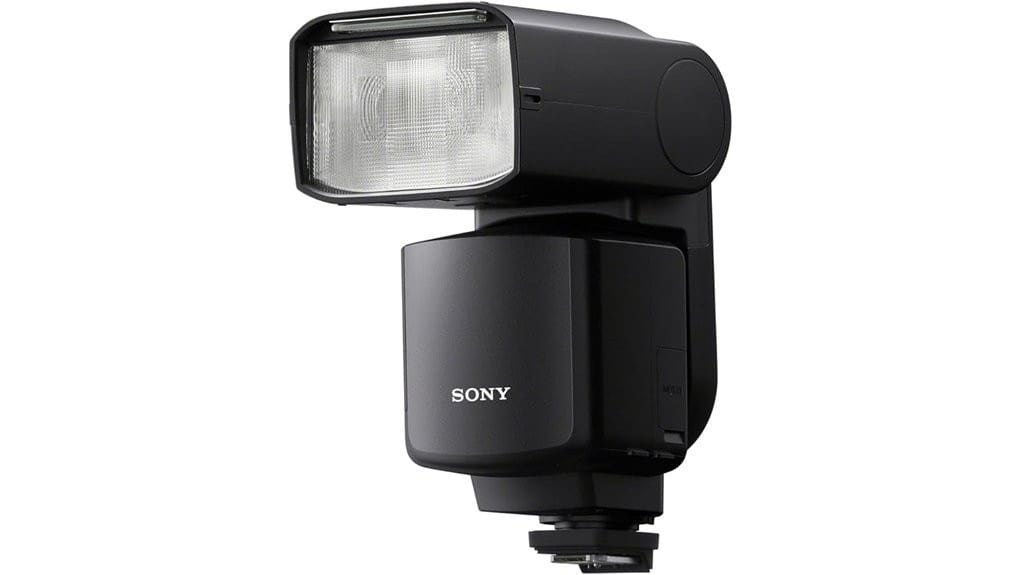
You’ll get a compact GN60 flash that’s powerful and reliable for Sony shooters, with GN60 output, 5500K daylight color, and built‑in radio TTL that stays consistent even during 10 FPS bursts. It’s quick to recycle on four AAs, offers focal‑length‑aware coverage to 200mm, and works best with modern Alpha bodies after firmware updates. It’s heavier than tiny units and not weather‑sealed, but ideal for events and portraits — keep going to see specifics.
Some Key Takeaways
- GN60 offers strong output (GN60) in a compact body, suitable for portrait and event work.
- Native radio TTL integrates well with recent Sony Alpha cameras for reliable off-camera triggering.
- 5500K daylight-balanced light gives neutral color and consistent in-camera results.
- Powered by four AA cells with fast recycling, but battery swaps interrupt very long shoots.
- Good beam coverage to 14mm–200mm; use included diffuser/bounce for softer, even portraits.
Sony GN60 HVL-F60RM2 At a Glance: Key Specs and What They Mean
While small enough to complement mirrorless bodies, the Sony GN60 HVL-F60RM2 packs pro-level power and modern wireless control into a concise package, so you get GN60 output, 10 FPS support, and radio TTL communication with recent Alpha cameras without lugging a bulky unit. You’ll appreciate the high guide number, focal-length-optimized output, and color-consistent 5500K light for varied shooting. Mount design follows Sony’s Multi Interface Shoe, so hot-shoe integration and camera-linked WB/face detection work seamlessly. Battery life depends on four AA cells—expect moderate runtimes with heavy use. Overall, it balances performance, compactness, and modern connectivity for Alpha users. White reflectors can help tame and shape the GN60 flash output for softer, more controlled light when needed, especially in portrait work with white photo reflectors.
How the GN60 Performs On-Camera: Exposure, P-TTL and Continuous 10 FPS Shooting
Because the HVL‑F60RM2 combines GN60 output with Sony’s per‑frame P‑TTL and radio TTL, you’ll get reliable exposures and consistent color even during fast bursts. You’ll find P‑TTL nails metering on mixed scenes, keeping exposure consistency frame to frame when subjects move or lighting shifts. Paired with Alpha bodies, the flash sustains TTL control through continuous 10 FPS shooting, so burst reliability isn’t just marketing—it lets you shoot action without repeated manual tweaks. Battery swaps can interrupt long runs, but for typical event and reportage use the GN60 gives predictable, repeatable results you can trust in-camera. For photographers using off-camera setups, wireless flash triggers can extend your control and creative possibilities when pairing the GN60 with other units, making multi-flash arrangements more reliable with radio control.
Lighting Quality and Coverage: Focal-Length Optimization, Color Temp, and Modifiers
Having consistent TTL and burst performance matters only if the light itself shapes your images the way you need it to. You’ll appreciate the GN60’s focal-length optimization: its wide panel to 14mm and zoom to 200mm lets you control spread without constant repositioning. Color temp sits near 5500K, giving neutral daylight tones that mix well with ambient light. Beam uniformity is good on-axis, though falloff appears at extreme wide angles—use the included bounce adaptor or modifier diffusion filters to soften hotspots. For portraits and events, you’ll get reliable, tweakable coverage; for creative edge lighting, plan modifiers carefully. For ring-light-style setups that prioritize even facial illumination, consider pairing the GN60 with a ring light system to blend focused flash with soft wraparound light.
Wireless Radio Control and Compatibility With Sony Alpha Bodies
If you need reliable off-camera flash without line-of-sight constraints, the HVL‑F60RM2’s built‑in radio control delivers it: you’ll get consistent triggering and stable exposure across groups and channels with Sony’s latest Alpha bodies that support the protocol. You’ll set up multi flash groups quickly using camera menus or the flash body, and radio sync stays solid out to practical studio distances. Check for firmware updates to maintain compatibility and fix quirks. Legacy compatibility is partial: modern Alpha bodies are fully supported, older models may need adapters or won’t expose every remote feature. Overall, it’s dependable for Sony shooters. For shooters who use external monitors, pairing your flash setup with an external camera monitor can streamline framing and exposure decisions external camera monitors.
Buy or Skip? Pros, Cons, Price Considerations and Who This Flash Is Best For
Those radio-control strengths make the buying decision straightforward for many shooters: pick the HVL‑F60RM2 if you need a powerful, reliable off‑camera flash that integrates tightly with modern Sony Alpha bodies. You’ll get excellent build quality, fast recycling with 4 AAs, and TTL performance that speeds workflow. Consider battery life for long events—carry spares or use high-capacity cells. Downsides: weight for travel, no weather sealing, and a premium price that may deter casual users. The accessory ecosystem and Sony compatibility boost resale value. Buy if you shoot portraits, events, or Sony-centric setups; skip if you need ultra‑light or budget gear. Many photographers who enjoy flash work also invest in dedicated speedlight gear to expand creative possibilities.
Some Questions Answered
Does It Support HSS (High-Speed Sync) With All Compatible Sony Bodies?
Yes — it supports high speed sync with compatible Sony bodies, but you’ll want to confirm specific High speed compatibility per camera. In practice it offers HSS with recent Alpha models that support radio TTL and HSS, enabling fast shutter use. Sync limitations appear with older or limited models that don’t fully implement radio HSS or P-TTL timing, so check your camera’s flash compatibility list before relying on HSS.
Can This Flash Be Used Off-Camera With Third-Party Radio Triggers?
Yes — you can use it off‑camera with third‑party triggers, but you’ll want to test for third party compatibility and trigger latency. The flash natively supports Sony radio control, so some triggers that emulate Sony’s Multi Interface Shoe protocols work better than dumb hotshoe triggers. You’ll get reliable TTL and high-speed sync only with compatible units; otherwise expect manual firing and potential latency or misfires. Test thoroughly before critical shoots.
Is There a Recycle Time Spec With Alkaline Vs Nimh Batteries?
Yes — Sony lists no exact recycle timings for alkaline versus NiMH, but you’ll get faster, more consistent recycle times with high-capacity NiMH cells versus alkalines. Battery types matter: alkalines drain quicker and give slower, variable recycle timings, especially at high output. Use fresh or high-capacity NiMH AAs for faster recovery and reliable continuous shooting. Consider rechargeable batteries for frequent use to maintain performance and battery longevity.
Are Firmware Updates Available and User-Installable via Camera?
Yes — firmware availability exists and you can usually update the flash via a compatible Sony camera; it’s camera installable for many Alpha bodies. You’ll want to check Sony’s support page for the HVL-F60RM2 firmware notes and your camera’s compatibility list. Follow Sony’s step-by-step instructions: connect the flash on the camera hot shoe, run the camera’s update utility, and keep batteries charged to avoid interruptions during the install.
What Is the Flash’s Flash Head Tilt/Swivel Angle Range?
The flash head tilts vertically from -7° down to 150° up and rotates (head rotation) 360° horizontally, so you can bounce light and do full swivel portraits. You’ll appreciate the wide vertical tilt for low-angle shots and the full head rotation for seamless left/right repositioning. It’s flexible for bounce, fill, and off-camera setups, and supports quick adjustments during fast-paced shooting, improving control and creativity.