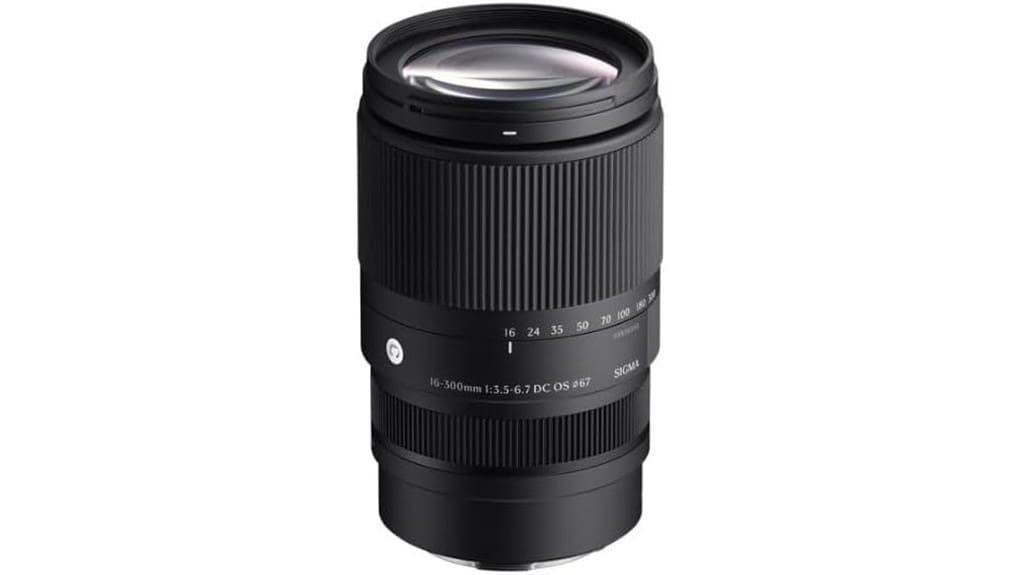
You’ll get a single, highly flexible 16–300mm zoom that favors reach, stabilization, and durability over prime‑level speed. You’ll lose peak sharpness and low‑light aperture but gain reliable OS (about 6 stops wide, 4.5 stops at 300mm), fast AF and predictable distortion correction. It’s ideal for travel, events and run‑and‑gun work where portability and versatility beat specialist optics. Keep it stopped down for best acuity and follow on for detailed tests, sample images and comparisons.
Some Key Takeaways
- Covers extreme 16–300mm range in one compact lens, ideal for travel and run‑and‑gun shooting.
- Maximum aperture of F3.5–6.7 sacrifices low‑light performance for versatility and lighter weight.
- Strong optical stabilization (≈6 stops wide, ≈4.5 stops at tele) makes handheld shooting practical.
- Good center sharpness up to ~100mm stopped down; edges soften and micro‑contrast dips at 300mm.
- Solid build with weather resistance, fast AF, predictable distortion, and RAW corrections recommended for best results.
Verdict and Best-Use Summary for the Sigma 16–300mm F3.5–6.7 DC OS Contemporary
Although it trades some maximum aperture for extreme reach, the Sigma 16–300mm F3.5–6.7 DC OS Contemporary gives you a single, highly versatile tool that covers wide-angle to super-telephoto needs with reliable optics, strong stabilization, and fast autofocus. You’ll appreciate travel versatility: one lens reduces kit weight and simplifies packing without sacrificing focal coverage. In the field workflow you’ll find quick framing, dependable OS (especially at wide end), and responsive AF that keeps subjects tracked. Use it for travel, events, and documentary work where flexibility and durability matter more than maximum aperture for low-light specialist tasks. It’s an excellent option for photographers who prioritize portability and tripod-friendly stability when shooting across varied focal lengths.
How the 16–300mm Range Performs: Sharpness, Distortion, and Optical Quirks
How sharp is the 16–300mm across its range, and where will you notice trade-offs? You get usable center acuity from 16–100mm stopped to f/5.6; sharpness falls toward edges at wide and tele extremes. Expect edge softening at both ends and increased chromatic fringing in high-contrast zones, correctable in RAW but present in-camera. At 300mm micro-contrast drops, revealing corner case aberrations such as veiling and mild astigmatism. Focus breathing is noticeable during close-focus pulls, affecting framing for video or tight compositions. Distortion is strong at extremes but predictable and largely fixable with profiles—optical compromises typical of super-zoom design. For many shooters these trade-offs are an acceptable exchange for the versatile focal range and convenience the lens provides.
Stabilization and Autofocus in Real-World Shooting (6 Stops Wide, 4.5 Stops Tele)
Count on the Sigma’s Optical Stabilization to make handheld shooting practical across most of the zoom range: you’ll get about 6 stops of compensation at the wide end and roughly 4.5 stops at 300mm, which translates to reliably usable shutter speeds in low light without a tripod. You’ll notice image stabilization tames handshake effectively, letting you push ISO lower or use slower shutter speeds for static subjects. Autofocus performance is fast and deliberate; tracking moving subjects is competent but not elite. In practice, the OS+AF pairing gives you high keeper rates for travel and run‑and‑gun shooting situations. Consider protecting this kind of versatile travel kit with a durable Pelican case to keep gear safe in transit.
Handling, Build, and Weather Resistance for Travel and Outdoor Use
When you sling the Sigma 16-300mm on a camera, its compact Contemporary chassis feels balanced for most APS-C bodies, letting you shift focal lengths without fighting torque or excessive front‑heaviness. You’ll appreciate lightweight handling on long walks; the lens won’t tax your strap or wrist. Build quality is solid — metal mount, robust plastics — and dust- and splash-resistant structure gives confidence outdoors. Grip comfort is good for extended use, though the zoom ring can be a touch stiff cold. Control layout is logical: focus, zoom, and OS switches are reachable. Front element has water- and oil-repellent coating for easier maintenance. Pairing this lens with a hiking backpack designed for cameras with dedicated compartments keeps your gear secure and accessible on the trail, especially when choosing packs made for camera compartment use.
Who Should Buy It and How It Compares Value-Wise to Alternatives
Although it sacrifices the absolute fastest apertures, the Sigma 16–300mm F3.5–6.7 DC OS Contemporary is a high-value, do-it-all super-zoom that suits photographers who prioritize range and convenience over specialist optics. You’ll appreciate its 16–300mm reach, strong OS (6 to 4.5 stops), and weather resistance if you’re shooting travel, events, or casual wildlife. It’s ideal for budget travelers and beginner wildlife shooters who need one lens to cover many scenarios. Compared with primes or pro zooms, you trade peak sharpness and low-light speed for versatility and cost-efficiency—excellent value when weight, space, and budget matter. It pairs especially well with entry-level DSLRs and mirrorless-adapted setups for photographers shopping for essential gear.
Some Questions Answered
Does It Come With a Lens Hood and Case?
Yes — it ships with a box pouch and a detachable hood. You’ll get a protective pouch for storage and transport, and a hood that mounts and removes easily. The pouch’s padding is basic but serviceable; it won’t substitute for a hard case. The detachable hood provides flare control and modest additional protection. You’ll want a dedicated hard case if you need superior impact resistance for heavy travel.
Is It Compatible With Full-Frame Canon RF Cameras?
No — it isn’t natively Full frame compatible on RF bodies; it’s a DC-format APS-C lens. You can use Mount adapterability to attach it to a Canon RF full-frame camera, but you’ll face automatic crop/APS-C mode, reduced resolution, and potential vignetting or black corners. Evaluate whether the telecentric performance and stabilization meet your needs on cropped output; for true full-frame coverage, choose a lens designed for full-frame RF.
What Filter Thread Size Does It Use?
The filter diameter is 67mm. You’ll screw standard 67mm filters directly onto the lens, and you can use thread adapters if you need to step up or down to other filter sizes. This lets you evaluate accessory compatibility quickly: small adapters keep weight low, but watch for vignetting at wide angles. Overall, the 67mm size balances common filter availability with manageable adapter options for versatile shooting.
Does It Support In-Camera Lens Corrections on Canon Bodies?
Yes — you’ll get in camera corrections on supported Canon bodies; the lens reports metadata so Canon cameras can apply distortion, vignetting and chromatic aberration profiles automatically. You shouldn’t need separate autofocus calibration on most bodies because the lens’s communication is accurate and autofocus performance is reliable. If you spot front/back focus you can still use body-level autofocus calibration tools, but typical use won’t require them.
Is There an Official Sigma Warranty for Rf-Mount Copies?
Yes — you’ll get an official Sigma warranty for RF-mount copies purchased through Sigma-authorized dealers. You’ll want to register the lens and keep proof of purchase to validate the Sigma warranty terms. If you buy from non-authorized sellers, manufacturers may refuse coverage, so consider Third party warranties for added protection. Evaluate warranty length, transferability, and repair scope; third-party plans can fill gaps but verify exclusions and service center access.