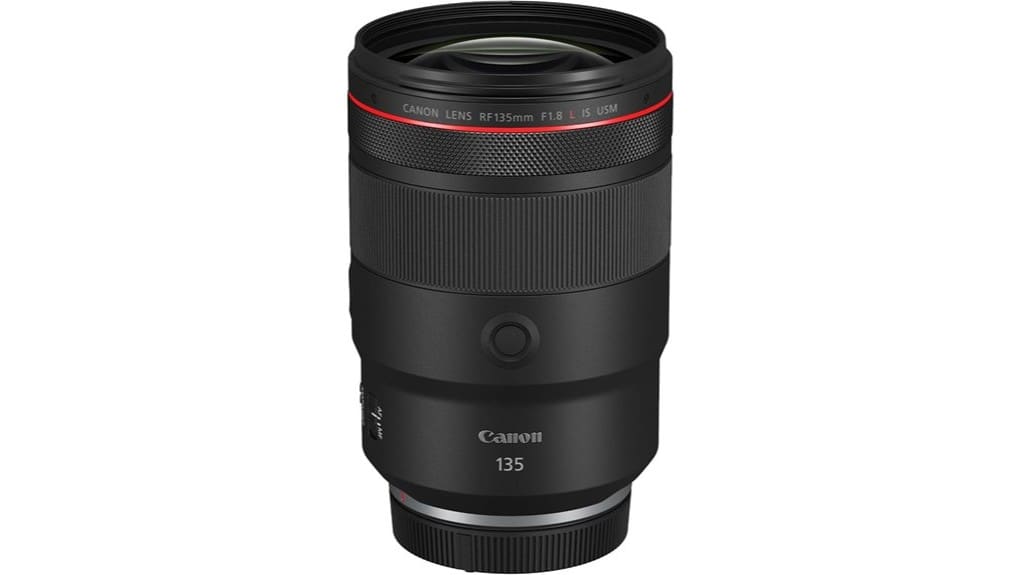
You’ll find the Canon RF 135mm F1.8 L IS USM is a pro-grade medium-telephoto prime that gives you razor-sharp portraits, creamy bokeh, and class-leading stabilization for handheld low-light work. It focuses fast and quietly with Nano USM, isolates subjects brilliantly at f/1.8, and tightens edges by f/2.8–f/4. Optical IS (up to 5.5 stops) plus EOS R IBIS makes it a go-to for pros; keep going and you’ll see detailed performance, comparisons, and buying advice.
Some Key Takeaways
- Exceptional f/1.8 sharpness with strong micro-contrast, delivering crisp portraits and detailed midframe resolution.
- Creamy, pleasing bokeh and controlled aberrations produce excellent subject isolation and smooth background rendering.
- Nano USM autofocus is fast, quiet, and reliable for portraits, moderate action, and video tracking.
- Optical IS provides up to 5.5 stops handheld stabilization, further improved with EOS R bodies’ IBIS.
- Premium build and ergonomics suit professionals, though weight, lack of full weather sealing, and price may deter casual users.
What the RF135mm F1.8 L IS USM Is and Who Should Consider It
When you need a medium-telephoto prime that balances blazing aperture, sharp optics, and reliable stabilization, the Canon RF135mm F1.8 L IS USM is built for that role. You’ll find a purpose-designed 135mm f/1.8 L-series prime that targets telephoto portraits, studio and location portraiture, and controlled-event shooting. Portrait specialists will value fast Nano USM AF, generous f/1.8 subject separation, and up to 5.5 stops of Optical IS (more with IBIS). You’ll appreciate robust build, programmable lens buttons, and compatibility with EOS R bodies. If you prioritize subject isolation and professional ergonomics, this lens should be on your shortlist. For photographers using tripods and heads, choosing the right support can further improve image sharpness and handling, especially with longer focal lengths and tripod compatibility.
How the Lens Performs: Sharpness, Bokeh, and Low-Light Capability
Having established why portrait and event shooters will be drawn to the RF135mm F1.8 L IS USM, let’s examine its optical performance under real-world conditions. You’ll find center sharpness exceptional wide open; micro-contrast and detail remain strong into the midframes. Edge sharpness tightens noticeably by f/2.8–f/4, useful for full-frame coverage. ASC and UD elements keep chromatic issues low; spherical aberration is controlled but can soften highlights at extreme defocus. Bokeh rendition is creamy with pleasing falloff, rendering backgrounds smoothly without nervous rings. Thanks to f/1.8 aperture and efficient light transmission, low-light capability is superb for handheld and subject-isolated work. For photographers interested in lens choice and techniques, consider exploring zoom lens basics to better match glass to shooting style.
Autofocus, Stabilization, and Handling in Real Shoots
Although the RF135mm’s Nano USM feels almost instantaneous on subjects, you’ll notice its tracking remains smooth and quiet whether you’re shooting stills or rolling video. You get fast tracking for portraits and moderate action, with autofocus locking predictably and recovering quickly from occlusions. Real world stabilization performs impressively handheld, delivering the stated 5.5 stops alone and tighter results with IBIS on compatible EOS R bodies. Smooth shifts between focus points avoid hunting in video, and two programmable buttons plus a well-placed focus ring give you ergonomic controls for immediate adjustments. Handling is balanced despite the weight, encouraging steady framing. For videographers who value fluid motion and precise control, pairing the lens with a quality fluid head can noticeably improve panning and tracking performance.
Comparisons: RF135MM Vs 85mm/135mm Alternatives and Legacy EF 135MM
Pulling focus and stabilization performance into account, it’s worth comparing the RF135mm against both shorter portrait primes and its EF 135mm predecessor to see where it stands in everyday use. You’ll notice stronger portrait compression and clearer focal isolation versus 85mm alternatives, yielding more flattering subject-to-background separation at similar framing. Background rendering is smoother thanks to improved optics and ASC-treated elements, reducing ghosts and aberrations versus older designs. Compared with the EF 135mm, this RF model offers modern IS, faster Nano USM AF, and updated coatings—an objective legacy comparison that highlights practical gains for portrait and low-light shooters without overstating minor trade-offs. Our site also recommends choosing the right ball head to maximize stability and control when using longer primes.
Value Verdict: Use Cases, Pros/Cons, Price-Worthiness and Buying Recommendation
If you want a portrait lens that doubles as a low-light and short-telephoto specialist, the RF135mm f/1.8 L IS USM delivers on that promise with few compromises. You’ll get razor-sharp portraits, strong subject isolation, reliable Nano USM AF, and up to 8 stops effective stabilization with compatible bodies. Use cases: pro portraits, event work, low-light candid, short-tele sports, and video. Pros: optical quality, fast aperture, IS, build. Cons: weight, non-water-resistant, premium price. Affordability analysis favors professionals and serious enthusiasts; casual shooters may balk. Resale value should remain high—recommend buy if you need its specific strengths. This lens fits well into a kit for photographers focused on prime lenses and image quality.
Some Questions Answered
Does This Lens Support Full-Time Manual Focus Override?
Yes — you get full time override with this lens. It lets you grab focus instantly without switching modes, and it doesn’t use a manual clutch; instead, the Nano USM and internal focus design provide seamless manual intervention. You’ll enjoy smooth, silent adjustments for stills and video, plus responsive AF when you release. The implementation feels precise and natural, supporting both quick tweaks and fine-focus control during shooting.
Can I Use Third-Party 82MM Filters Safely?
Yes — you can safely use third-party 82mm filters, provided you verify filter compatibility with the lens thread and choose reputable brands. Expect coating differences: premium filters match Canon’s multi-coatings to minimize reflections, ghosting, and color cast, while cheaper ones may introduce flare or slight color shifts. Test critical shots, avoid cheap uncoated glass for wide-open f/1.8 work, and prioritize multi-coated, color-neutral options for best results.
Is the Lens Compatible With Canon RF to EF Adapters?
Yes — you can use RF-to-EF mount adapters to mount RF lenses on EF bodies, but you shouldn’t expect full compatibility. You’ll need a proper mount adapter that preserves electronic contacts and accounts for flange distance differences; otherwise AF and stabilization may be affected. Because RF and EF flange distances differ, adapters alter register alignment. Confirm the adapter supports electronic communication and test AF/IS performance on your specific camera before relying on it.
How Does the Lens Perform for Video Autofocus Eye Tracking?
Yes — you’ll get reliable video autofocus eye tracking. The Nano USM delivers smooth continuous focus shifts with minimal noise, and combined with EOS R bodies’ AF algorithms it maintains subject retention on faces and eyes even when framing or distance changes. You’ll still want to test for rapid occlusions or extreme low light, but overall it’s authoritative, fast, and well-suited for run-and-gun portrait and interview video work.
Are Firmware Updates Available for the Lens?
Yes — Canon provides firmware updates for the lens. You’ll find firmware updates and release notes on Canon’s support site, detailing improvements and fixes. Check the support timeline regularly to see past and scheduled updates; Canon doesn’t promise a fixed update frequency, so releases vary by need. You’ll download firmware, follow the installation steps, and review release notes to confirm compatibility and resolved issues before updating.