
You’ll get a compact, pro-grade 24–70mm f/2.8 that gives strong center sharpness at f/2.8 and noticeably better edges by f/4, with refined color, microcontrast, and well-controlled chromatic aberration (minor 24mm fringing correctable in RAW). Autofocus is fast and repeatable on Sony E bodies, and the shorter, mixed-metal/polycarbonate build improves handling and balance without in-lens stabilization. It ships with hood and caps plus optional accessory bundles, and if you want specs, comparisons, and real-world samples you can keep going.
Some Key Takeaways
- Consistent f/2.8 across 24–70mm delivers reliable low-light performance and exposure control for portraits and events.
- Excellent center sharpness at f/2.8, with improved edge resolution by f/4 and refined microcontrast.
- Fast, repeatable autofocus and solid subject tracking on Sony E-mount bodies, including APS-C and full-frame.
- Lightweight, compact build with metal/polycarbonate mix improves handling, balance, and portability versus earlier models.
- Good chromatic aberration control and smooth bokeh; slight 24mm fringing correctable in RAW.
What You Need to Know Fast: Sigma 24–70mm F/2.8 DG DN II Art at a Glance
While not the lightest option in its class, the Sigma 24–70mm f/2.8 DG DN II Art gives you a versatile, professional-grade standard zoom with a constant f/2.8 aperture, improved rendering and sharpness, and a shorter, lighter body compared with its predecessor. You get 24–70mm coverage, constant exposure control, and Sony E-mount compatibility for APS-C and full-frame bodies. Technical strengths include refined color rendering, updated optics, and bundled accessories. Consider a price comparison against rivals for value versus build and features. Note: it lacks formal water resistance; stabilization is handled digitally/optically by camera systems. Essential lens gear supports photographers with camera lens accessories and expertise.
How Sharp and Reliable Is It? Real-World Image Quality and Autofocus Performance
How sharp is the Sigma 24–70mm f/2.8 DG DN II Art in real shooting conditions, and how dependable is its AF? You’ll find center sharpness very strong from f/2.8 onward across 24–70mm, with microcontrast and resolution resolving fine detail; edges improve noticeably by f/4. Chromatic aberration is well controlled in most scenes, though high-contrast edges at 24mm can show slight fringing that’s correctable in RAW. Autofocus is fast, repeatable, and tracks reliably on Sony bodies, with minimal hunting. Bokeh rendition is smooth for subject isolation, with natural roll-off and modest background separation at longer focal lengths. For photographers looking to extend reach without replacing lenses, teleconverters can be a useful option when paired with compatible lenses and bodies, offering increased focal length with some trade-offs in light and autofocus performance teleconverter compatibility.
Handling, Size, and Build: Shorter, Lighter Body Compared to Previous 24–70 Models
Beyond sharpness and AF performance, the lens’s handling and physical design have a direct impact on how you use those optical strengths in the field. You’ll notice the shorter, lighter body reduces fatigue during handheld shooting and improves balance on smaller Sony E bodies. Mechanical refinements yield tangible ergonomic improvements: repositioned zoom and focus rings, a firmer zoom lock, and a reduced rotating mass for quicker framing. Build quality combines metal and high-grade polycarbonate for stiffness without excess weight. Tactile controls are precise—the focus throw is smooth, detents are consistent, and the aperture ring (when present) clicks predictably for repeatable operation. This makes it a great fit for mirrorless camera users who prioritize portability and handling.
Who Should Buy This Lens? Use Cases, Compatibility With Sony E Cameras, and Alternatives
If you shoot with Sony E-mount bodies and need a single, high-performance standard zoom that balances image quality, speed, and portability, this Sigma 24–70mm f/2.8 DG DN II Art is built for you. You’ll benefit if you prioritize portrait lighting control at 70mm and shallow depth of field, require travel versatility for varied scenes, or cover events where f/2.8 and fast AF matter. It pairs with APS-C and full-frame Sony E models listed earlier, retaining resolution across the range. Consider alternatives like Sony’s FE 24-70mm GM for ultimate refinement or third-party zooms if weight, cost, or specific rendering differ. This makes it an excellent match for photographers who prefer carrying a dedicated camera shoulder bag to protect and access their gear quickly.
Value Check: Included Accessories, Price Considerations, Pros vs Cons, and Final Recommendation
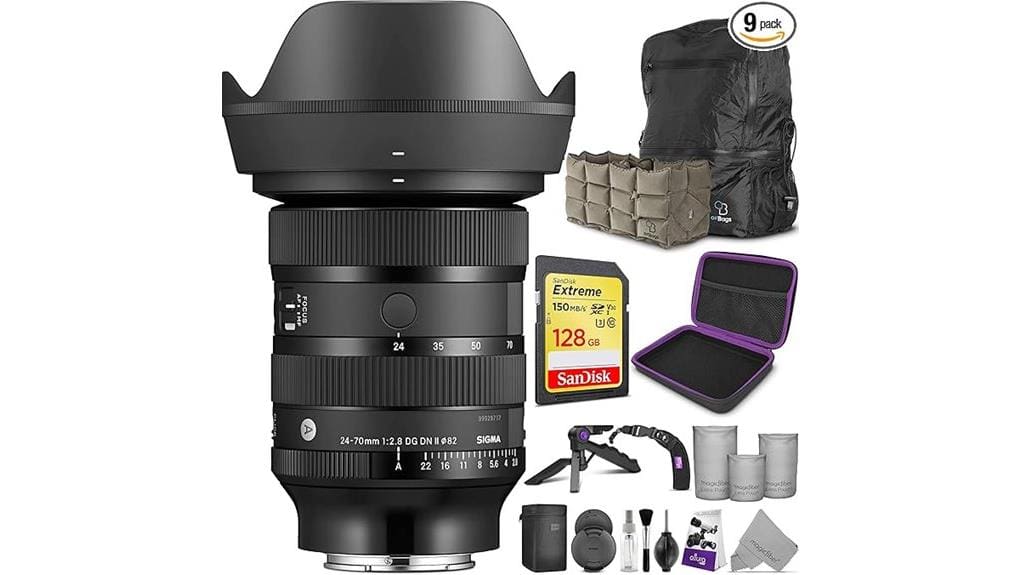
Although the lens itself is the centerpiece, the bundled items materially affect the overall value—you get the Sigma lens with its hood, rear cap, and 82mm front cap plus a protective case, and the Altura Photo + SanDisk bundle supplements that with an AirBag packable bag and insert, mini tripod, wrist strap, hard-shell case, cleaning kit, three microfiber pouches, and a 128GB SanDisk Extreme SDXC card. You’ll pay a premium for Art-series optics, but the extras lower initial accessory spend versus buying separately. For street photography the fast f/2.8 and compact weight justify cost; consider budget alternatives if price-sensitive. Check resale value and extended warranty terms. Many photographers find a dedicated camera bag insert helps organize and protect kits when using compact packable bags.
Some Questions Answered
Does This Lens Support In-Camera Stabilization on All Sony Bodies?
No — it doesn’t provide in body stabilization on all Sony bodies. You’re dealing with a lens optical stabilizer listed as digital, optical, but the lens lacks its own IBIS. On Sony cameras with in-body stabilization (IBIS), the camera will stabilize; on bodies without IBIS you’ll rely on the lens/system stabilization modes. So compatibility depends on the camera: IBIS-equipped Sony bodies will deliver stabilization, others won’t unless the lens optical stabilizer is active.
Can I Use Third-Party ND or Polarizing Filters Without Vignetting?
Yes — you can use third-party ND or polarizing filters, but watch for vignetting if you stack filters or use thick mounts. The lens has an 82mm filter thread; choose slim, high-quality CPL/ND filters to minimize corner shading, especially at 24mm and wide apertures. If you plan to stack filters, test combinations at wide focal lengths and stop down if needed. Use a matte hood and avoid excessive stacking for best edge-to-edge performance.
Is the Lens Sealed Against Dust and Light Moisture Exposure?
No — the lens isn’t fully sealed; it lacks thorough weather resistance and won’t withstand heavy rain. You’ll find some basic rubber gasketting at the mount on many Sigma Art lenses, but this model is listed as not water resistant. So you shouldn’t expose it to sustained moisture or dust storms. Use protective measures like a rain cover, quick-dry wipes, and cautious handling to reduce risk during marginal conditions.
Does the Lens Have Electrical Contacts for EXIF Aperture Control?
Yes — the lens provides aperture communication via electrical contacts and uses an electronic diaphragm, so your camera controls aperture and records EXIF aperture values. You’ll get full Aperture communication for metering and exposure modes, with autofocus and aperture set through the Sony E-mount interface. This design enables precise aperture reporting in files and seamless integration with camera exposure modes, though the lens itself isn’t rated as water resistant.
Are There Firmware Updates Available for the Autofocus System?
Yes — firmware availability exists for maintaining autofocus improvements; you can check Sigma’s support site and authorized service centers for updates. You’ll download specific firmware files and follow Sigma’s updater instructions or have service techs install them. Firmware notes typically list enhanced AF algorithms, tracking stability, and compatibility fixes. Keep camera body firmware updated too, since lens and camera firmware interact to optimize autofocus performance and reliability.