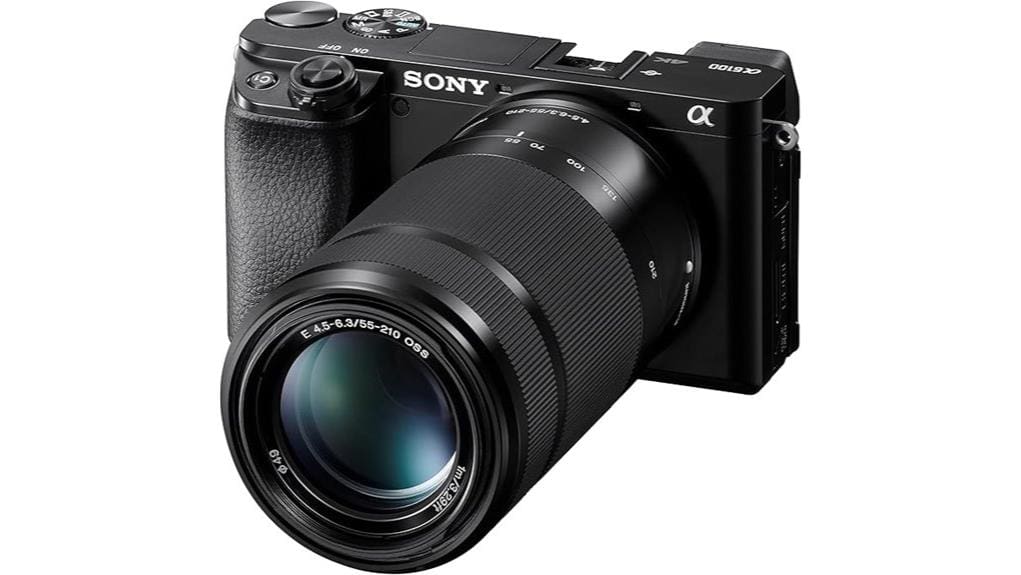
You’ll get a compact, fast mirrorless that pairs a 24.2MP APS-C sensor with the BIONZ X processor, Real-time Eye AF and 11 fps continuous shooting for reliable subject tracking. It shoots clean 4K video, offers a bright EVF and flip touchscreen, and performs well to about ISO 3200–6400. Battery life and no in-body stabilization are trade-offs, but bundled kits cover most needs. Keep going and you’ll find deeper specs, handling notes, and lens recommendations.
Some Key Takeaways
- Excellent 24.2MP APS-C image quality with fast BIONZ X processing and reliable color rendition for stills and RAW workflows.
- Industry-leading autofocus: 425 phase-detect points, 0.02s lock, and Real-time Eye AF for people and animals.
- 11 fps continuous shooting with AF/AE tracking, suitable for casual sports, wildlife, and family action.
- 4K UHD video with touch tracking and manageable rolling shutter, ideal for travel vlogging and hybrid creators.
- Compact, affordable body lacking IBIS and with a single UHS-I slot and modest NP-FW50 battery life.
Intent & Quick Verdict: Is the Sony Alpha A6100 Worth Buying?
If you’re weighing options for a compact, fast, and affordable APS-C mirrorless, the Sony Alpha A6100 deserves serious consideration: it pairs a 24.2MP Exmor sensor and BIONZ X processor with class-leading 0.02s autofocus, Real-time Eye AF for people and animals, and 11 fps continuous shooting—features that punch well above its entry-to-midlevel price. You’ll get a versatile kit with 16–50mm and 55–210mm lenses, strong AF coverage, and 4K video. Compared to budget alternatives, the A6100 balances performance and portability, and its steady resale value keeps upgrade paths practical if you later move to higher-end Alpha bodies. The site also offers essential accessories for mirrorless users, including camera bags and lens care products.
Who This Camera Is For and Best Use Cases
Because it blends fast, reliable autofocus, solid image quality, and compact portability, the A6100 is ideal for enthusiasts and content creators who want pro-level AF without the size or cost of full-frame bodies. You’ll appreciate the 0.02s AF, Real-time Eye AF, and 11 fps for action, so it’s great for family events, casual sports, and wildlife on a budget. Pairing small zoom kits makes it perfect for travel vlogging—light carry, flip screen, and clean 4K. For street photography, its discreet body, quick AF, and responsive controls beat bulkier DSLRs, letting you react faster and stay unnoticed. Its compact form factor also pairs exceptionally well with lightweight travel tripods for extended shooting and vlogging setups lightweight tripods.
Key Specs That Matter: Sensor, AF, Video, and Performance
You’ll notice the A6100’s headline specs line up with what many hybrid shooters need: a 24.2 MP APS-C sensor paired with Sony’s BIONZ X + front-end LSI gives you detailed 6000×4000 stills and 4K UHD video with manageable noise up to expanded ISO 51,200, while the 425 phase-detection and 425 contrast-detection AF points that cover roughly 84% of the frame deliver the 0.02 s lock speed, Real-time AF/Real-time Eye AF, and 11 fps continuous shooting that make tracking moving subjects far more reliable than on most consumer compacts; put simply, this combo favors fast, accurate subject capture and high-resolution output without forcing you into a larger, heavier full-frame system.
You’ll get respectable dynamic range and 14-bit color depth for grading, with low autofocus latency that keeps you on target. Frame rate consistency at 11 fps with AF/AE tracking is strong for APS-C bodies, though buffer depth and UHS-I card limits modestly constrain long bursts. Video shooters benefit from 4K detail and touch tracking, but note there’s no in-body stabilization, so lens OSS or gimbals matter for smooth clips. Overall, the performance balance suits mixed-still/video workflows where speed and image fidelity both count. As a photography-focused accessory tip, consider compact lavalier microphone options when recording interviews or behind-the-scenes footage.
Real-World Image and Video Quality: Photos, Low Light, and 4K Footage
Dive straight into how the A6100 handles real shooting scenarios: its 24.2 MP APS-C sensor and BIONZ X processor deliver crisp, high-detail JPEGs and RAW files with clean midtones and good fine-detail rendition at base ISO, letting you pull strong 6000×4000 crops without visible softness. You’ll appreciate natural color rendition and competitive dynamic range for this class; lens sharpness often dictates ultimate detail resolution. In low light performance the camera surprises — usable high ISO handling to ISO 3200–6400 with manageable noise. Autofocus reliability, including eye detection, keeps subjects locked. 4K stability is solid; rolling shutter is modest. Consider pairing the camera with a field monitor to better judge exposure and focus during video shoots.
Handling, Controls, Screen, and EVF Experience
When you pick up the A6100, its compact mirrorless body feels balanced and familiar, letting you operate it confidently for extended shoots without fatigue. You’ll notice a logical button layout with customizable C-buttons and a useful control wheel; the thumb grip gives secure one-handed support. The EVF is bright with minimal lag, offering accurate framing compared with entry-level rivals. The 3.0″ tilting touchscreen is responsive for touch AF and menus, though serious users may add screen protectors to avoid wear. Menu responsiveness is snappy thanks to BIONZ X; steering through settings feels faster than many competitors. If you’re shopping for accessories to improve handling, consider choosing the right camera grip designed specifically for mirrorless bodies to enhance comfort and control.
Lenses, Stabilization, and Accessories to Complete the Kit
To round out the A6100 kit, focus on optics and stabilization that match its APS-C sensor and fast AF — the bundled 16–50mm and 55–210mm cover general-purpose framing and reach, but you’ll likely want at least one faster prime or an all-purpose zoom with wider apertures for low-light work and shallower depth of field. Consider Lens options like a 35mm f/1.8 or 16–70mm f/4 OSS for sharper corners and better low-light performance. Since the body lacks IBIS, prioritize lenses with OSS or a gimbal. Accessory essentials: extra NP-FW50 batteries, UHS-I V30 cards, UV/ND filters, and a compact tripod. For easy travel and stable shots, pairing the kit with a lightweight travel tripod designed for photographers makes a noticeable difference.
Pros, Cons, and Final Buying Recommendation
Having covered lenses, stabilization, and key accessories, let’s weigh the A6100’s strengths and weaknesses so you can decide if it matches your needs. You get excellent AF speed, versatile kit lenses, 4K capture, and reliable color science that pleases skin tones and landscapes. Drawbacks include no in-body stabilization, modest battery life with the NP-FW50, and a single UHS-I slot limiting heavy video workflows. Compared to competitors, the A6100 balances price and performance for hybrid shooters who prioritize autofocus and image quality over long handheld video sessions. Recommend it if you value responsiveness and compact versatility. We also offer a range of video light kits to help improve your lighting for better photography and video results.
Some Questions Answered
Does the Kit Include Batteries and a Charger?
Yes — a battery included: the kit ships with one NP-FW50 lithium battery and an AC charger (AC-UUD12) in the box, so charger omitted isn’t the case. You’ll likely want a spare battery for extended shoots since only one is supplied. Consider a travel charger or USB charging solution for longer trips; compared to buying extras later, bundling a spare plus travel charger gives better uptime and convenience.
Is the Camera Compatible With Third-Party E-Mount Lenses?
Yes — you can use third-party E-mount lenses on the camera; Sony E is an open mount with broad third party compatibility. You’ll often get full AF and exposure support from quality Sigma, Tamron, Samyang, and Sony-certified lenses. If you want to fit non-E optics, mount adapters (Metabones, Viltrox, Fotodiox) work well, but expect varied AF speed, functionality and possible crop/compatibility quirks compared to native E-mount glass.
Can It Record External Audio via a Microphone Input?
Yes — you can record external audio via a microphone input. You’ll plug an external microphone into the A6100’s 3.5mm mic jack for clearer sound than the internal mic provides. You can also use audio adapters if you need XLR or lavalier integration; compare adapters for phantom power and preamp quality. You’ll get better dialogue and wind rejection, but remember there’s no dedicated headphone jack for real‑time monitoring.
What Memory Card Type and Speed Are Recommended?
Use UHS II compatibility cards for future-proofing, but the camera’s slot is UHS‑I; you’ll get full performance with UHS‑I. Prefer cards rated V30 endurance (minimum sustained 30 MB/s) for reliable 4K recording and continuous burst shooting. Compare brands: choose high-endurance V30 UHS‑I cards from Sony, SanDisk or Lexar; if you upgrade to UHS II cameras later, UHS II cards will be backward compatible here.
Is There In-Body Image Stabilization (IBIS) in the A6100?
No — the A6100 doesn’t have IBIS. You’ll rely on lens based stabilization or electronic stabilization for steady shots, since Sony didn’t include sensor shift mechanisms in this model. That means stabilized lenses (OSS) or careful technique give best results, and crop/rolling-shutter effects can differ from bodies with built-in IBIS. If you need multi-axis compensation, consider an A7-series or newer Sony body with true sensor shift mechanisms.