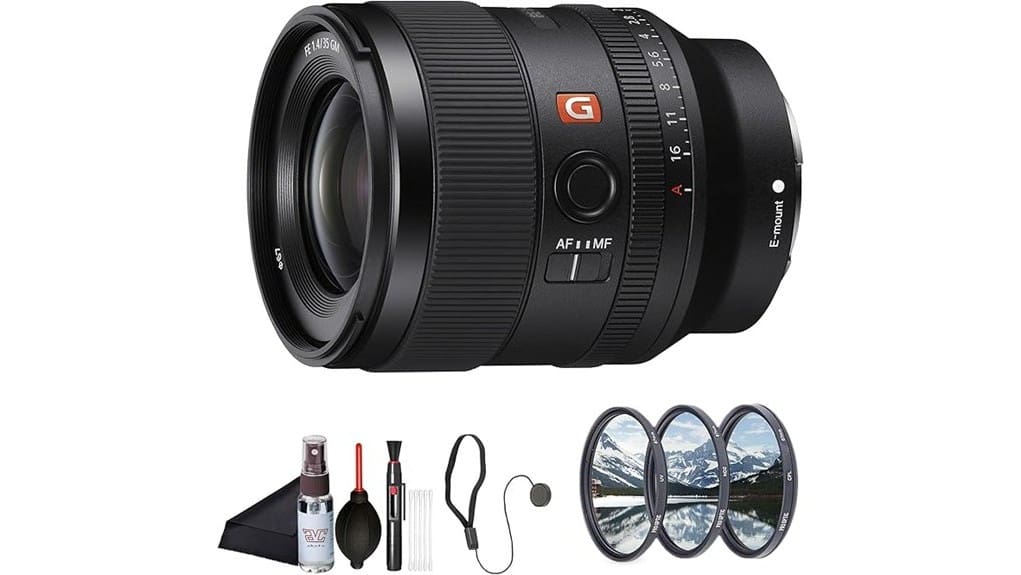
You’ll get a pro-grade 35mm that pairs ultra-bright f/1.4 optics with two XA elements, ED glass and Nano AR II coating to deliver exceptional center-to-edge sharpness, controlled chromatic and spherical aberrations, and smooth 11-blade bokeh. Dual XD linear motors give fast, quiet AF with precise manual override and minimal focus breathing for video. It excels in low light, portraits, street and gimbal work, and if you keep going you’ll find detailed comparisons, tests and practical tips.
Some Key Takeaways
- Exceptional optics: two XA elements and ED glass deliver edge-to-edge sharpness and minimal chromatic aberration.
- Superb low-light performance: bright f/1.4 enables faster shutter speeds and lower ISO for cleaner images.
- Smooth, pleasing bokeh: 11-blade diaphragm and corrected spherical aberration produce creamy backgrounds with minimal onion rings.
- Fast, quiet AF and handling: dual XD linear motors, internal focusing, and precise manual override suit stills and video.
- Professional value: outperforms kit primes with class-leading features, ideal for portraits, street, events, and gimbal use.
What the Sony FE 35mm F1.4 GM Is Good For (Street, Portraits, Video)
Because it combines a classic 35mm field of view with an ultra-bright f/1.4 aperture, the Sony FE 35mm F1.4 GM is a highly versatile tool for street, portrait, and video work. You’ll exploit natural perspective for environmental portraits, rendering subjects within context while isolating them with shallow depth of field. For street and travel narratives, the focal length captures scenes without distortion, remaining compact for handheld mobility. Video benefits from quiet, fast XD Linear Motors and stable internal focus for gimbal use. Low-light F1.4 performance yields higher shutter speeds and cleaner ISO, giving you technical control and creative flexibility. It’s also an excellent match for gimbal stabilizers that help achieve smooth, cinematic motion with compact setups gimbal stabilizers.
Detailed Optics and Image Quality: Sharpness, Bokeh, and Aberration Control
When you push the Sony FE 35mm F1.4 GM to its limits, its optical engineering delivers consistently high resolution and controlled aberrations: two XA (extreme aspherical) elements and ED glass work together to straighten field curvature and suppress chromatic aberration, while Nano AR Coating II reduces flare and ghosting for higher microcontrast. You’ll notice center-to-edge sharpness from wide-open to stopped-down apertures, preserving fine detail and optical micro contrast. The 11-blade diaphragm and corrected spherical aberration produce a smooth bokeh rendition with minimal onion rings or nervous outlines. Overall aberration control and contrast retention make it a precise, professional optic. Our store also carries essential lens calibration tools to help you maintain that level of focus precision.
Autofocus, Handling, and Video Performance (XD Motors, Eye AF, Gimbal Use)
Tap into the FE 35mm F1.4 GM’s autofocus system and you’ll notice a blend of speed, silence, and stability engineered for both stills and motion. You get dual XD Linear Motors delivering rapid, accurate subject acquisition with minimal noise, enabling reliable silent tracking during continuous AF and Eye AF for humans and animals. Internal focusing preserves gimbal balance and reduces front-heaviness as focus shifts, so your stabilization stays consistent. Manual focus override is precise, and focus breathing is controlled for video. Overall handling feels purposeful: robust, well-damped focus ring action and secure mounting make this lens a practical tool for hybrid shooters. Enhance your setup with an external camera monitor for improved composition and focus confirmation external camera monitors.
Real-World Low-Light and Depth-of-Field Tests With Sample Use Cases
Although the FE 35mm F1.4 GM excels on paper, real-world low-light tests show how its F1.4 aperture, advanced optics, and 11-blade diaphragm translate into practical advantages: you’ll routinely shoot at shutter speeds 1–3 stops faster than with slower primes, achieve usable ISO reductions that lower noise without sacrificing detail, and render subjects with pronounced subject-background separation even in tight interiors. In practice you’ll use it for environmental portraits, street scenes at dusk, and event work where shallow dof isolates subjects. XA elements and Nano AR II retain microcontrast under mixed lighting, while silent XD motors maintain focus during long exposures. The lens’s optical design and build quality make it a top choice for photographers seeking prime lens performance.
How It Compares and Who Should Buy It (Alternatives, Value, and Final Verdict)
Having seen how the FE 35mm F1.4 GM performs in low-light and shallow-depth-of-field scenarios, it’s worth comparing its optical and handling characteristics against close alternatives and clarifying who will get the most value from it. You’ll find its XA elements, Nano AR II, 11-blade aperture and dual XD motors deliver class-leading sharpness, bokeh and AF. In a price comparison it sits above standard kit primes but below boutique, hand-built options; third party alternatives like Sigma and Tamron offer cheaper, lighter choices with compromises in bokeh and AF speed. Buy it if you prioritize ultimate image quality, build and video-friendly handling. Our store also offers a selection of lens adapters that can help you use legacy glass with mirrorless bodies.
Some Questions Answered
Is This Lens Weather-Sealed for Shooting in Rain?
Yes — you get robust weather seal durability, with thorough gaskets at the mount and critical joints, so you can shoot in rain with reasonable confidence. The lens isn’t fully waterproof, but its moisture resistant coatings and sealed construction repel splashes and light drizzle. You should still avoid prolonged exposure, heavy downpours, or submersion; use an external rain cover for extended wet conditions to protect electronics and optics.
What Is the Filter Thread Size and Included Filters?
The filter size is 67mm, and the included filters come as a 3-piece kit. You’ll get a 67mm filter size thread on the lens, and the included filters typically cover common needs (e.g., UV/protective, circular polarizer, and neutral density). This setup preserves optical performance while allowing control over reflections, polarization, and exposure for video or stills. Threading is standard, so swapping or stacking filters is straightforward.
Does It Support In-Camera Optical Stabilization?
No — it doesn’t provide in-body optical stabilization. You’ll rely on the camera body’s stabilization system (IBIS) for stabilization in body, while the lens itself lacks optical stabilization elements. That design prioritizes optical performance, compactness and fast AF via dual XD Linear Motors. For stabilized handheld shooting, pair it with a Sony body offering IBIS; you’ll retain excellent sharpness, low-light capability and smooth video when body stabilization is active.
How Heavy Is the Lens for Travel and Handheld Use?
You’ll find the lens compact but slightly hefty for long handheld sessions, weighing about 524 grams (18.5 oz). You’ll benefit from a balance of professional optics and manageable bulk: it’s portable for travel and street work, yet you’ll notice the weight during extended handheld shooting. You’ll rely on its internal focusing and ergonomics to maintain stability, and you’ll likely pair it with a supportive strap or brief rests for comfort on long days.
Is There a Focus Ring De-Click Switch for Video Work?
No — there’s no dedicated de-click switch for video work. You’ll get a smooth, damped linear focus feel and precise manual override via the focus ring, but it remains continuous without click stops. That linear focus response and quiet dual XD motors let you shift between AF and manual override seamlessly, giving accurate, repeatable pulls suitable for gimbal and run-and-gun shooting while preserving low-noise operation for recording.