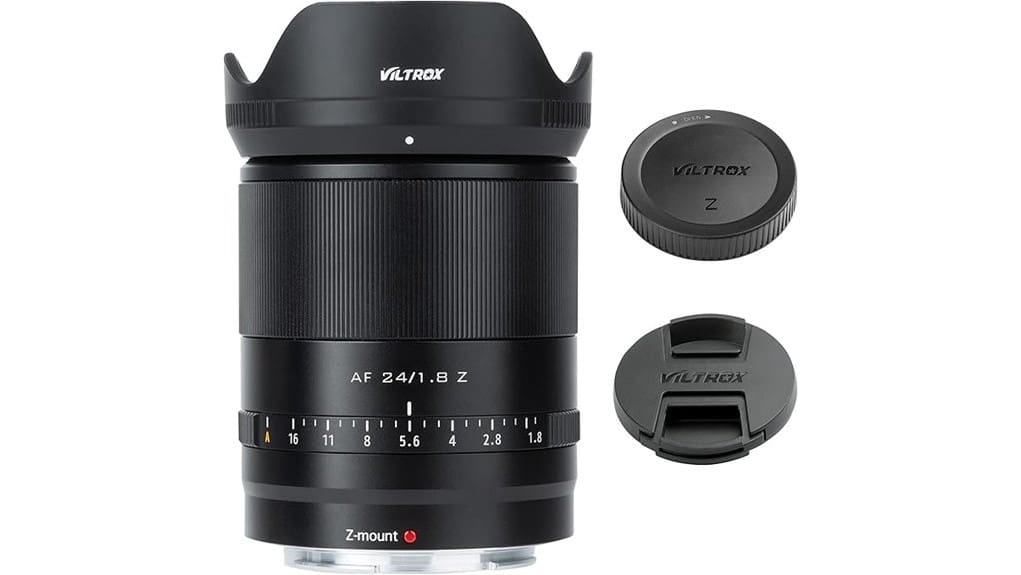
You’ll find the Viltrox AF 24mm f/1.8 Z‑mount gives you a compact, fast wide‑angle with strong center resolution at f/1.8 that tightens through f/2.8–f/5.6, predictable STM autofocus, and quiet operation for stills and video. Corners improve stopped down but won’t fully match central acuity on full‑frame Z bodies, and you’ll see measurable vignetting wide open plus mild barrel distortion and some lateral CA in high‑contrast peripheries. Scroll on for full technical notes and practical tips.
Some Key Takeaways
- Excellent center sharpness from f/1.8, peaking between f/2.8–f/5.6, with edges improving when stopped down.
- Quiet, fast STM autofocus on Nikon Z bodies with smooth tracking and minimal focus breathing for video and vlogging.
- Strong f/1.8 low-light performance and smooth 11-blade bokeh, though vignetting is noticeable wide-open.
- Chromatic aberration and flare are well controlled by ED elements and Nano AR coating, with some lateral CA at high-contrast edges.
- Compact, lightweight build with USB-C firmware updates but no weather sealing or in-lens stabilization.
Real-World Sharpness, Bokeh, and Low-Light Performance (24mm F1.8 in Practice)
Although wide-angle lenses like this often get judged on their edges, the Viltrox AF 24mm F1.8 delivers this in spades: center resolution is strong at F1.8 and tightens up further by F2.8–F5.6, while corners show noticeable improvement stopped down but won’t match the central acuity on a full-frame Z body. You’ll observe consistent edge sharpness improvement from F2.8 onward; chromatic aberration is controlled by the ED elements and Nano AR coating. In low light the fast F1.8 aids exposure and reduces ISO needs, and nighttime bokeh renders highlights with smooth, 11-blade curvature and restrained onion-ring artifacts. For photographers who often use tripods, pairing this lens with a quality ball head can improve composition stability and ease of adjustment.
Autofocus, Video, and Handling: AF Speed, Noise, Focus Breathing, and Build
Having established how the 24mm F1.8 performs optically, you’ll want to know how it behaves when focusing and recording: Viltrox uses an internal STM with a lead-screw stepping motor that delivers generally quick, smooth AF on Nikon Z bodies and keeps the optical block compact for video use. You’ll observe fast AF in single and continuous modes with predictable tracking, and the lightweight focus group supports quiet operation ideal for vlogging. Measurements show minimal breathing during focal shifts; it’s not eliminated but remains unobtrusive. The metal-plastic hybrid barrel, responsive aperture ring and tactile switches provide ergonomic controls for handheld shooting. The lens is a practical choice for photographers who may also benefit from lens calibration accessories to maintain accurate focus over time.
Optical Quirks and Image Quality Details: Distortion, Vignetting, Chromatic Aberration, and Coatings
While the Viltrox AF 24mm F1.8 Z-Mount delivers generally clean rendering, you’ll notice a few measurable optical quirks that affect edge performance and high-contrast scenes. Distortion is mild barrel-type, predictable and easily corrected in-camera or in RAW converters without notable sharpness loss. Vignetting is significant wide-open at F1.8, producing measurable edge falloff that improves markedly by F4–F5.6. Lateral chromatic aberration appears at high-contrast edges toward the frame periphery but stays controllable by profile corrections; longitudinal CA is minimal. Nano AR lens coatings reduce ghosting and flare in backlit situations, though strong light sources can still induce low-level veiling. Many shooters who enjoy creative perspectives also pair such lenses with fisheye accessories to explore unique compositions.
Who Should Buy This Lens: Use Cases, Camera Pairings, and Alternatives to Consider
For photographers and videographers seeking a compact, sharp wide-angle with fast aperture, the VILTROX AF 24mm F1.8 Z-Mount fits situations where mobility, low-light performance, and reliable autofocus matter more than absolute microcontrast or built-in stabilization. You’ll want this lens if you shoot street photography or travel vlogging—its 24mm field, F1.8 brightness, and quiet STM suit run-and-gun scenarios and handheld video. For astro landscapes the fast aperture and low-weight system help framing and tracking, though you’ll rely on camera stabilization or tripod. Pair with Z50 or Z6 II for balance; consider native Nikon 24mm primes if you require top-tier microcontrast. It’s a solid choice for mirrorless users who prioritize portability and versatility, especially those building a kit focused on compact mirrorless gear.
Practical Buying Notes: Size, Filters, Firmware, Warranty, and Final Verdict
Because size and practical details often decide whether a lens fits your workflow, start by noting the VILTROX AF 24mm F1.8 Z‑Mount’s physical footprint and accessory needs: it measures about 86.7 mm long, 70 mm in diameter, and weighs ~370 g, so it balances well on Z50 or Z6-series bodies without adding bulk, but you’ll still want a small protective pouch for travel; the filter thread is primarily specified as 55 mm (one spec sheet lists 69 mm—confirm with your seller before buying filters or lens caps); firmware updates come via the built-in USB‑C port so you can apply AF and performance patches at home; the lens lacks weather sealing and in‑body image stabilization, so plan on protective measures and rely on camera IBIS or tripods for low‑light shots; and warranty terms vary by seller/manufacturer, so check local coverage and service options before completing your purchase. This lens is a good match for photographers who value compact gear and often pair bodies with portable storage solutions like portable SSDs for field work.
Some Questions Answered
Does This Lens Support In-Camera Subject-Detection AF for Z-Series Cameras?
Yes — you’ll get in camera AF subject detection with this lens on Z-series bodies. The lens communicates AF signals and supports camera-driven subject detection, including eye/face and animal detection where the camera firmware enables it. You’ll rely on the camera’s AF system for tracking; the lens provides fast, quiet STM-driven internal focus and firmware-upgradeable compatibility via USB-C to maintain or improve subject detection performance.
Is There a Removable Lens Hood Included or Available Separately?
No, a removable hood isn’t included in the box; you’ll need to source third party hoods if you want one. You can attach compatible removable hoods sized for 55 mm filter threads (verify thread spec) or clip-on designs that suit the 70 mm diameter. Choose a rigid petal or round hood matching the lens profile to avoid vignetting. Check fit, mount type, and clearance for the manual aperture ring before purchasing.
How Compatible Is the USB-C Firmware Update With macOS and Windows?
The USB C compatibility is generally good: you’ll update firmware on macOS and Windows via the lens’s USB‑C port using Viltrox/Chengzhen utility. You’ll need the correct driver package on Windows; driver issues sometimes require installing Zadig or unsigned driver approval. On macOS, you’ll likely just run the updater (may need security permissions for kernel extensions). Always use the latest utility, follow instructions, and back up camera files before updating.
Can the Manual Aperture Ring Be De-Clicked or Locked for Video Use?
Yes — you can use the manual aperture ring in a clickless mode for video. The ring supports clickless aperture adjustment enabling smooth, continuous exposure changes; it also provides a tactile lock to prevent accidental rotation when you need fixed settings. You’ll switch between clicked and clickless positions using the ring’s detent mechanism, and engage the tactile lock for firm resistance. This suits filmmaking, vlogging, and controlled aperture pulls where silent, precise control matters.
Are There Known Issues With Focus Confirmation or EXIF Compatibility on Older Z Bodies?
Yes — you may encounter occasional focus confirmation and exif mismatch issues on older Z bodies. You’ll find focus confirmation can be inconsistent with early firmware, causing misleading AF indicators. EXIF mismatch (incorrect lens model or focal-length reporting) has been reported until lens firmware or camera updates resolve it. You should update both camera and lens firmware, test focus behavior, and verify EXIF fields in RAW/preview to confirm compatibility.