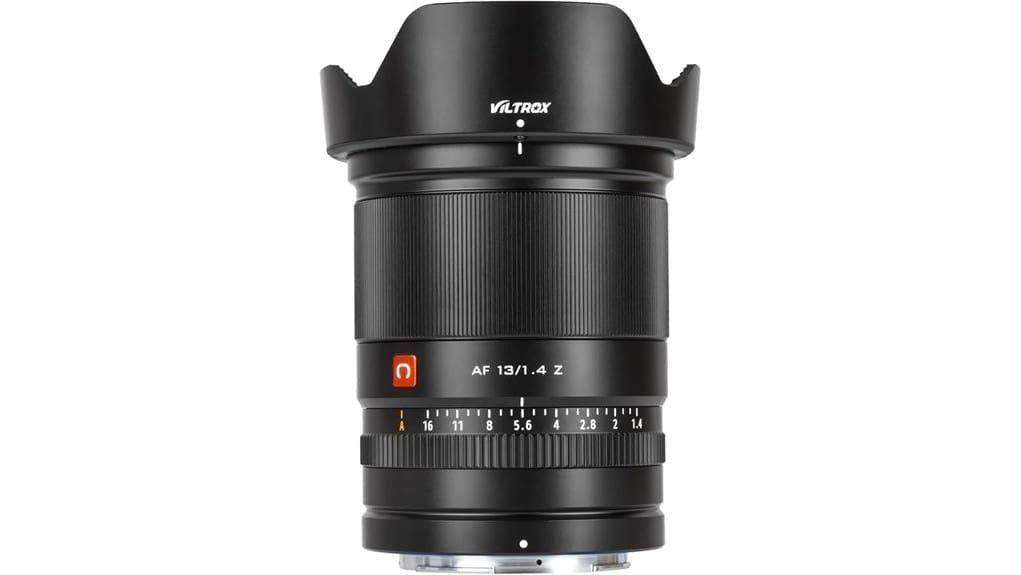
If you shoot Nikon Z and want an ultra‑wide that’s both compact and bright, the Viltrox 13mm f/1.4 Z gives exceptional low‑light performance and uncommon shallow DOF for 13mm. You’ll get strong center sharpness at f/1.4, reliable face/eye AF on Z bodies, and a quiet STM plus de‑clicked aperture for video. Expect barrel distortion and noticeable vignetting wide open, improved by stopping down. Keep going to see detailed optics, handling, and value analysis.
Some Key Takeaways
- Compact, fast f/1.4 ultra-wide prime for Nikon Z APS-C bodies, ideal for low-light and shallow depth-of-field work.
- Excellent center sharpness at f/1.4, reaching uniform edge-to-edge sharpness around f/4.
- Reliable face/eye AF and quiet STM focus, though moving subjects may challenge tracking.
- Noticeable barrel distortion and vignetting wide-open, both are correctable in-camera or during post-processing.
- Great value vs native options, lightweight for vlogging, but lacks optical stabilization—use IBIS or gimbal for steady video.
Quick Verdict: Who This VILTROX 13MM F/1.4 Z Lens Is Best for
While it’s ultra-wide and bright, the VILTROX 13mm f/1.4 Z is best for APS-C Nikon Z users who need a compact, low-light-capable prime for street, vlog, and creative close-up work; you’ll get fast eye/face AF, a shallow depth-of-field option uncommon at this focal length, and a smooth STM motor and manual aperture ring that suit both stills and video production. You’ll appreciate its compactness if you shoot handheld, its f/1.4 for selective-focus street portraits, and its vlog compatibility via lightweight form and quiet STM focus. It’s aimed at hybrid shooters prioritizing portability and creative wide-angle framing. It’s a good match for mirrorless enthusiasts looking for essential, camera-specific accessories and lenses to complement their kit.
Real-World Performance: Low-Light, Autofocus, and Close-Up Shooting
When you push the VILTROX 13mm f/1.4 into low-light scenarios, its bright aperture and fast STM motor let you keep shutter speeds higher and ISO lower than typical ultra-wides, yielding cleaner images and more usable video. You’ll find low light portraits benefit from the wide field and shallow depth control, though composition differs from longer lenses. Autofocus reliability is strong for static subjects and face/eye detection works consistently on Nikon Z bodies; moving subjects can expose the lens’s focus limits. Close-up shooting to 22 cm is practical for environmental detail and vlogging, with smooth manual aperture action for video. For photographers looking to fine-tune focus performance, consider using lens calibration tools to perfect edge-to-edge sharpness.
Optical Quality Breakdown: Sharpness, Distortion, Vignetting, and Bokeh
Having covered how the 13mm f/1.4 handles low light, autofocus, and close-up work, we now examine its core optical characteristics: sharpness across the field, geometric distortion, vignetting behavior, and the rendering of out-of-focus areas. You’ll find center sharpness is excellent at f/1.4, with microcontrast improving toward f/2.8; edges require stopping down to f/4 for uniformity. Distortion is predictable wide-angle barrel, correctable in-camera or in post. Vignetting is noticeable wide-open but falls off by two stops. Chromatic aberration is well controlled, and coma control is adequate for night-sky points. Bokeh shows smooth, if slightly busy, highlights. This lens is particularly useful for wildlife and sports photographers seeking reach and subject isolation with wide apertures and telephoto performance.
Handling and Video Features: Size, Focus Motor, Aperture Ring, and Vlog Use
Because the 13mm f/1.4 keeps a compact, lightweight profile, you’ll find it well-suited for handheld vlogging and run-and-gun video work without adding bulk to a Z-series body. Its compact handling reduces fatigue and improves framing speed on Z5, Z6, Z30 and similar bodies. The step-less STM focus motor delivers smooth, near-silent shifts and reliable eye/face detection AF for run-and-gun interview or walk-and-talk shots. A manual, de-clicked cinematic aperture ring gives precise exposure pulls and shallow depth-of-field control. No stabilization means you’ll rely on in-body IS or gimbals for steady footage, but focus and aperture tools are video-ready. Perfect Tripods offers accessories that pair well with compact lenses for improved handling and stability when vlogging with mirrorless cameras, like the compact tripods ideal for Z-series setups.
Buy or Skip? Pricing, Alternatives, and Final Buying Recommendation
If you’re weighing value against specific needs, the VILTROX 13mm f/1.4 Z strikes a compelling balance for budget-conscious Z-mount users who prioritize ultra-wide, low-light capability and compact handling. You’ll find the street price undercuts native Nikon ultra-wides; a clear price comparison favors Viltrox for focal length and aperture per dollar. Consider alternative mounts only if you need different camera systems—adapters exist but may affect autofocus. Check resale value trends: third-party primes hold moderate demand, so depreciation is reasonable. Hunt bundle deals to lower effective cost. Recommendation: buy if you need bright, portable ultra-wide performance on Z bodies. Prime lenses often deliver superior image quality and optical performance compared to zooms, making them a staple for enthusiasts and pros alike.
Some Questions Answered
Does This Lens Come With a Lens Hood or Carrying Case?
Yes — the retail packaging includes hood; it doesn’t include a case. You’ll find the lens, a petal-type lens hood, front and rear caps, and documentation listed under box contents. The kit’s compact, aimed at Vloggers and street shooters, but there’s no protective carrying case provided. If you need dedicated transport or weather protection, plan to purchase a small padded pouch or hard case separately for safer handling and storage.
Is It Weather-Sealed for Outdoor Use?
No — it’s not weather-sealed. You shouldn’t rely on this lens for heavy rain or dusty environments because it lacks robust environmental sealing and formal weather resistance. In light moisture or brief outdoor use you can operate carefully, but avoid prolonged exposure. For reliable outdoor/pro-level shooting choose a lens with documented weather resistance and sealed mounts; otherwise use protective covers and quick-dry routines to mitigate potential moisture and dust ingress.
Can It Be Adapted for Full-Frame Nikon Z Cameras?
Yes — you can mount the lens on full-frame Nikon Z bodies, but it’s designed for APS-C so it’ll vignette unless you use DX crop mode. You’ll retain the 13mm focal length on the sensor area used, and manual focus remains available if you prefer precise control. Expect reduced coverage on full-frame sensors, potential optical compromises, and reliance on camera crop or post-crop to avoid heavy edge shading.
Does It Support In-Camera Lens Corrections and Firmware Updates?
Yes — you can use firmware compatibility and correction profiles: the lens supports in-camera correction profiles on compatible Nikon Z bodies, enabling automatic distortion and vignetting correction. Firmware updates for the lens are provided by VILTROX; you’ll need to check the manufacturer site for update files and installation instructions. You should confirm your specific Z camera model supports lens firmware transfer and correction profile application before updating to guarantee full compatibility and correct operation.
What Accessories (Filters, Caps) Are Compatible With the 67MM Thread?
You can use any 67mm accessories: screw-on lens caps, rear caps, and common filters like UV filter and Neutral density filters. Choose multi-coated UV for protection and anti-reflective ND or variable ND for exposure control. Also consider a 67mm circular polarizer and thin (low-profile) filter rings to minimize vignetting on the ultra-wide 13mm. Use a compatible lens hood and clamp-style filter holder for rectangular filters when needed.