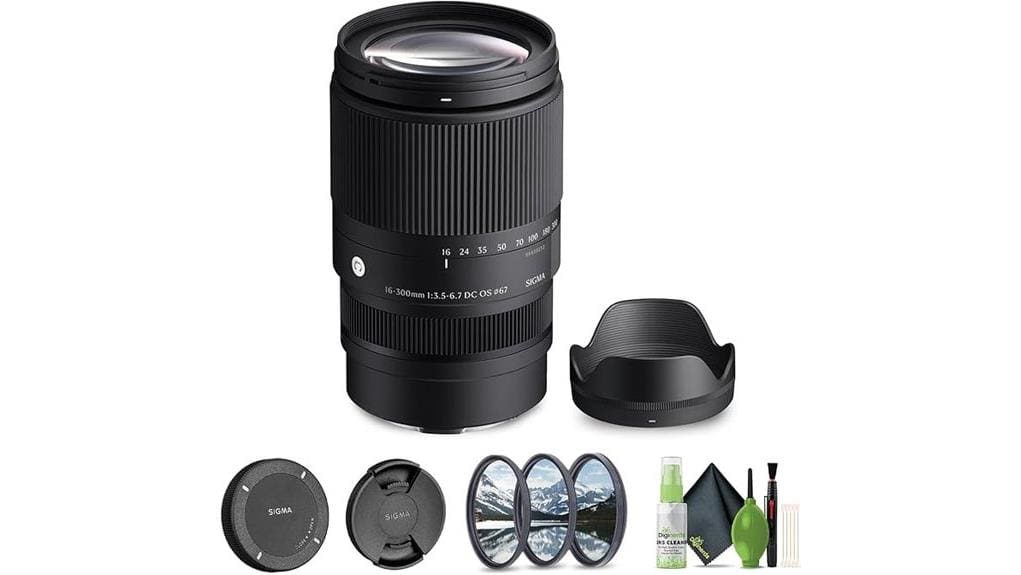
You’ll get a single, weather‑resistant 16–300mm f/3.5‑6.7 zoom that’s aimed at travelers and beginners who want one compact, stabilized lens for landscapes, portraits and distant subjects. It delivers strong short‑to‑midframe sharpness, OS2 stabilization for several stops of handheld exposure, and quick, quiet HLA autofocus; expect softness and reduced microcontrast at the extreme tele end plus modest apertures. Build is solid with a zoom lock and splash resistance, and more detailed performance notes follow.
Some Key Takeaways
- Lightweight, weather-resistant 18.8x zoom (16–300mm) ideal for travel and everyday use.
- Optical Stabilization (OS2) and HLA autofocus deliver steady handheld shots and quiet, responsive focusing.
- Strong sharpness at short to mid focal lengths, with some softness and microcontrast loss at the extreme tele end.
- Compact Contemporary build, zoom lock, and near-macro capability make it versatile for landscapes, portraits, and close-ups.
- Good value for a single‑lens kit, but compare against Sony and Tamron superzooms for sharpness and aperture trade-offs.
Quick Verdict: Who Should Buy the Sigma 16‑300mm and Why
If you need one lightweight, weather‑resistant lens that covers wide-angle to telephoto for travel, events, and everyday shooting, the Sigma 16–300mm delivers a practical all‑in‑one solution with a true 18.8x zoom range (16–300mm; 24–450mm equivalent on APS‑C) and optical stabilization—ideal for photographers who prioritize versatility and convenience over interchangeable specialty glass. You’ll find it suits budget travelers and beginner vloggers who want a single carry-on optic that handles landscapes, portraits, and distant subjects. It’s compact, splash-resistant, and offers near-macro capability; you’ll trade fastest apertures for range and simplified kit management. Consider pairing it with a lightweight tripod for travel to maximize stability and framing flexibility.
Real-World Performance: Sharpness, Stabilization, Autofocus, and Video
When you put the Sigma 16–300mm on a Sony E body, it delivers competent real‑world performance: sharpness is strong across the frame at short to mid focal lengths with some softness toward the extreme tele end, the OS2 stabilization reliably lets you handhold several stops slower shutter speeds, the HLA autofocus is quick and quiet for stills and decent for tracking, and video capture up to 1080p benefits from both steadying OS and minimal focus noise. You’ll find measured corner falloff at wide apertures, mild focus breathing during rack focus, and accurate color rendition with neutral tones. Contrast holds up; microcontrast drops at long end. Essential lens gear for better photography enthusiasts often includes versatile zooms like this one, which can simplify kit selection and shooting decisions for lens buyers.
Handling and Build: Size, Weather Resistance, Zoom Lock, and Ergonomics
Although compact for an 18.8x zoom, the Sigma 16–300mm feels balanced on most Sony E bodies and stays manageable for handheld shooting thanks to its 1.4 lb claimed weight and 4.8 in length. You’ll appreciate the compact handling: barrel action is smooth, zoom ring firm, and focus ring responds without play. Weather sealing and a water- and oil-repellent front element give confidence in damp conditions, though not full submersion. A mechanical zoom lock prevents creep at longer focal lengths. The molded ergonomic grip offers secure contact for extended use, while build quality matches Contemporary-class expectations for durability and portability. Many photographers use protective hard cases like Pelican cases to safeguard lenses during travel.
Use-Case Breakdown: Travel, Wildlife, Portraits, Vlogging, and Macro Shots
Having confirmed the lens’ compact handling, weather resistance, and secure zoom mechanics, you can now assess how that practicality maps to real shooting scenarios. For travel, lightweight portability and creative focal lengths let you cover landscapes to distant details without lens changes. Wildlife benefits from the extended reach; stabilization and HLA autofocus support handheld tracking but expect limits in low light. Portraits are serviceable at mid-tele focal lengths though shallow-background separation is modest. Vlogging uses the wide end with OS active for smoother handheld clips; microphone placement and stabilization-dependent crop matter. Near-macro at 70mm yields useful close-up detail for product and nature studies. Consider pairing the lens with a compact travel tripod to maximize stability and framing options during long exposures and telephoto shooting.
Value and Alternatives: Price, Kit Contents, Warranties, and Comparable Lenses
Because the Sigma 16-300mm packs broad focal coverage, built-in stabilization, and weather resistance into a single compact package, it delivers clear value for shooters who prioritize versatility and minimal gear changes. You’ll assess price comparison against native Sony zooms and third-party superzooms; Sigma often undercuts OEM options while matching utility. Bundle value is strong: lens, hood, caps, pouch plus optional filter and cleaning kits reduce immediate accessory spend. Check warranty options—retailer return windows and Sigma’s standard coverage differ by region. For competing alternatives, consider Tamron and Sony E superzooms for size, sharpness, or faster apertures depending on priorities. Also consider buying from authorized dealers to ensure warranty coverage and genuine accessories.
Some Questions Answered
Is This Lens Compatible With Full-Frame Sony E Cameras?
No — you won’t get full-frame compatibility. This APS-C Sigma lens is designed for Sony E crop bodies, so full frame incompatibility means you’ll face vignetting or camera-imposed crop modes on full-frame bodies. Expect crop factor effects: the 16–300mm behaves like ~24–450mm on APS-C; on full-frame it will either be cropped or heavily vignetted, reducing effective resolution and field of view unless you use a dedicated APS-C mode.
Can I Use ND or Polarizing Filters With the 67MM Thread?
Yes — you can use ND and polarizing filters with the 67mm thread. Your filter compatibility is 67mm, so screw-on neutral density or circular polarizers designed for 67mm will mount directly without adapters. Use slim-profile filters to minimize vignetting at 16mm equivalent. Circular polarizers are recommended for metering and AF systems. Make certain high-quality, multi-coated filters to preserve contrast and minimize flare while maintaining optical stabilization performance.
How Does the OS2 Stabilization Affect Long-Exposure Handheld Shots?
You’ll get noticeable shutter speed gains with OS2: expect up to about 4–6 stops of stabilization at wide angles in practical handheld long-exposure use, letting you shoot much slower without blur. Stabilization tradeoffs include potential slight framing drift and reduced effectiveness at extreme telephoto or very long exposures; you’ll still need a tripod for multi-second exposures or precise composition, and moving subjects can introduce residual blur.
Does the Lens Support In-Camera Lens Corrections and Metadata?
Yes — you’ll get in-camera lens corrections and metadata when your camera supports firmware compatibility and Sigma correction profiles. The lens transmits focal length, aperture, and focus data to Sony E bodies; supported cameras apply distortion, vignetting, and chromatic aberration corrections using built-in correction profiles. Make sure your camera firmware is up to date for full profile recognition. RAW converters also use Sigma/Adobe profiles to embed or apply correction metadata during processing.
Is the Lens Suitable for Professional Wedding Photography Backup Use?
Yes — you can use it as a backup for professional weddings. Its backup suitability comes from broad wedding versatility: 16–300mm covers wide-to-tele, OS2 stabilization gives up to 6 stops, and fast HLA autofocus offers reliable tracking. It’s compact, weather-resistant, and includes zoom lock and protective accessories. Limits: variable f/3.5–6.7 affects low-light and bokeh, so primary fast primes remain preferable for critical moments.