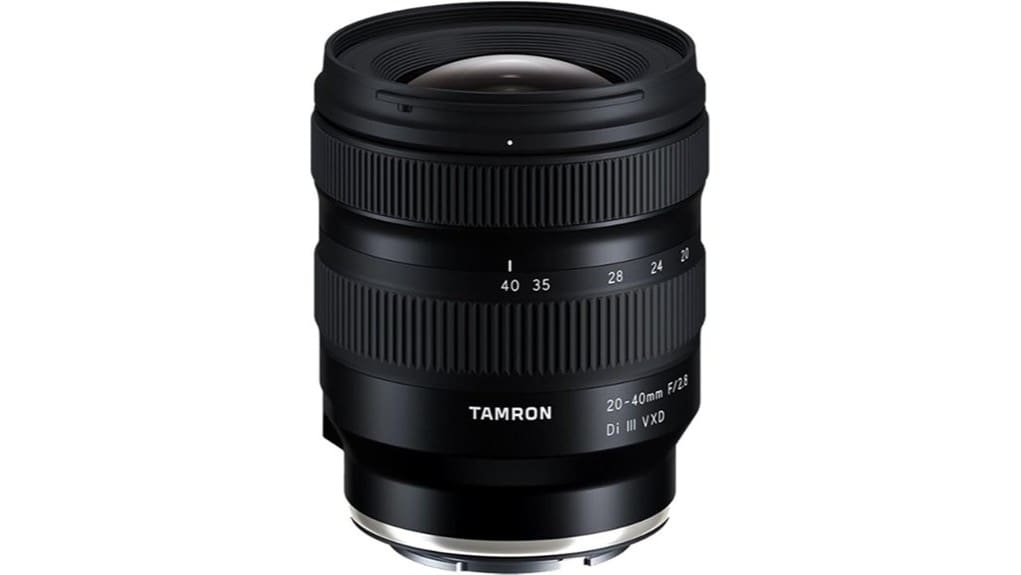

You’ll find the Tamron 20–40mm f/2.8 Di III VXD gives you true constant f/2.8 across a practical ultra‑wide-to-standard range in a very compact 12.9 oz package for Sony E bodies. Center sharpness is excellent at f/2.8, corners tighten by f/4–5.6, and bokeh is pleasing from nine rounded blades. VXD linear AF is fast and quiet for stills and video; controls and weather resistance suit travel shooters. Keep going to see detailed optical and handling tradeoffs.
Some Key Takeaways
- Lightweight, compact constant f/2.8 zoom for Sony E full-frame bodies, weighing just 12.9 oz with included hood and caps.
- Excellent center sharpness at f/2.8; corners improve by f/4–f/5.6, with slight edge softness wide-open at 20mm.
- VXD linear-motor AF delivers fast, quiet single-shot and reliable continuous tracking, matching modern Sony bodies.
- Good bokeh from nine rounded blades, minimal focus breathing, 0.17 m MOD and 1:3.8 close-focus capability.
- Strong value for travelers and street shooters needing portable, weather-resistant f/2.8 coverage; consider discounts if you own similar primes.
Tamron 20–40mm F/2.8 at a Glance : Key Specs and Who It’s for
Looking for a compact, fast wide-to-normal zoom for Sony full-frame mirrorless bodies? You get a 20–40mm f/2.8 Di III VXD with a constant f/2.8 aperture, 12 elements/11 groups, 9-blade diaphragm, 67mm filter, and VXD linear-motor AF. It weighs 12.9 oz, measures 3.4 in, is moisture-resistant, and includes hood and caps. The design emphasizes compact travelability and aperture consistency for low-light and shallow depth-of-field control across the zoom range. You’ll pair it with Sony E bodies (A1/A7/A9 families, ZV, FX30, select APS-C bodies) when you need versatile wide-to-normal coverage in a small package. It’s an appealing option for mirrorless camera enthusiasts seeking compact travelable gear for everyday and travel photography.
Real‑World Optical Performance: Sharpness, Bokeh, Distortion, and Close‑Up Capability
While small and lightweight, the Tamron 20–40mm f/2.8 delivers impressively crisp center resolution across the frame at f/2.8, with corner sharpness improving markedly by f/4–f/5.6; you’ll notice slight softness wide-open at 20mm edges but usable detail for most real-world applications. You get pleasing, smooth bokeh from nine rounded blades at f/2.8, though background rendition tightens toward 40mm. Distortion is modest and corrects well in RAW profiles; lateral chromatic aberration is controlled but can appear at high-contrast edges. Coma control for off-axis highlights is strong. Focus breathing is minimal. Close-up work benefits from a 0.17 m MOD and 1:3.8 magnification despite residual edge softness. This makes it a compelling option for portrait shooters who prefer compact, fast zooms with portrait-friendly optics.
Autofocus, Handling, and Video Usability on Sony E Bodies
The Tamron 20–40mm f/2.8 uses a VXD linear-motor AF that locks on quickly and quietly on Sony E bodies, giving you fast single-shot and reliable continuous tracking for both stills and video; responsiveness is comparable to native Sony primes on recent A7/A9-series bodies and holds focus well with subject motion. You get fast AF and consistent video AF performance via Sony body integration, including eye and face detection. The compact lens offers smooth handling—balanced on most A7 bodies—with a damped zoom ring and responsive focus ring. Focus breathing is minimal for typical run-and-gun work, aiding framing stability. It’s also a great match for gimbal stabilizers, thanks to its compact size and balanced handling that work well with smooth shots.
How It Compares to Alternatives (Sony and Third‑Party Zooms and Primes)
Having established how the VXD AF and handling perform on Sony E bodies, it’s useful to compare the Tamron 20–40mm f/2.8 directly with competing zooms and primes to see where it trades off size, speed, and optical performance. You’ll find the Tamron’s weight comparison favors portability: 12.9 oz versus heavier native f/2.8 zooms. Build durability matches weather-resistant Sony alternatives but lacks metal heft some pros prefer. Optically, it holds up on sharpness and color rendition, though primes can edge it in microcontrast. Flaring resistance is good thanks to coatings, but extreme sun angles reveal more veiling than premium glass. The lens is a great match for photographers who travel light and use compact support systems like travel tripods.
Final Verdict: Value, Ideal Users, and When to Buy
Because it balances a true f/2.8 aperture, ultra-wide-to-standard coverage, and a very compact 12.9‑ounce body, the Tamron 20–40mm f/2.8 Di III VXD delivers high practical value for photographers who prioritize portability without sacrificing low‑light speed or focal flexibility. You’ll get reliable VXD autofocus, close-focus capability (0.17 m, 1:3.8), and moisture resistance in a small footprint. It’s ideal for budget conscious travelers and street photography enthusiasts who need versatility on Sony E bodies. Buy if you value low weight, constant f/2.8 performance, and focal-range efficiency; wait for discounts if you already own similar fast primes. It’s a strong match for those seeking lightweight tripods to complement travel photography gear.
Some Questions Answered
Is This Lens Weather‑Sealed Enough for Shooting in Light Rain?
Yes — you can shoot in light rain, but cautiously. You’ll benefit from the lens’s weather resistance and generally good seal quality, yet it’s not fully sealed like pro DSLR super-telephotos. Rain performance is reliable for brief exposures and light drizzle; avoid prolonged downpours. Check gasket presence at the mount and keep caps/hood used. If you expect heavy moisture, add extra protection (rain cover) to guarantee safe operation.
Does It Support In‑Camera Optical Stabilization on Sony Bodies?
Yes — it relies on in‑camera stabilization on Sony bodies. You’ll use the camera’s IBIS for shake reduction because the lens has no optical stabilization. Autofocus and communication operate via the VXD motor and Sony protocol; keep your lens firmware updated through TAMRON Lens Utility to guarantee compatibility and performance with IBIS, focus ring functions, and firmware-driven improvements across camera body models and future system updates.
Can the Focus Ring Be Customized via Tamron Lens Utility?
Yes — you can customize the focus ring behavior via TAMRON Lens Utility. You’ll connect the lens to the utility to assign custom focus functions, adjust ring response, and update firmware. The software lets you switch ring modes (e.g., AF/DMF/manual), reverse rotation, and set focus ring sensitivity for precise manual control. This custom focus capability improves tactile response for stills and video, maintaining consistent, repeatable behavior across compatible Sony bodies.
What Filter Types or Polarizers Work Best on the 67MM Thread?
Use 67mm circular polarizers (CPL recommendations: slim, multi-coated) and 67mm UV protection filters. You’ll want a slim-profile CPL to avoid vignetting at 20mm; choose multi-resistant coatings (AR, water/oleo) for flare reduction. For UV protection pick a high-transmission, scratch-resistant glass with multicoating. If you stack filters, use a thin CPL first and standard UV second. Quality brands and proper cleaning preserve optics and autofocus performance.
Is There a Lens Hood Replacement or Third‑Party Hood Compatibility?
Yes — you can replace the hood; Tamron’s OEM hood fits perfectly, and several aftermarket hoods and petal alternatives are compatible via the 67mm mount and bayonet. You’ll want a low-profile, precisely indexed petal design to avoid vignetting at 20mm. Choose rigid ABS or aluminum for durability, confirm bayonet alignment and inner anti-reflective finish, and check seller photos for exact fit before buying to guarantee secure attachment and full coverage.