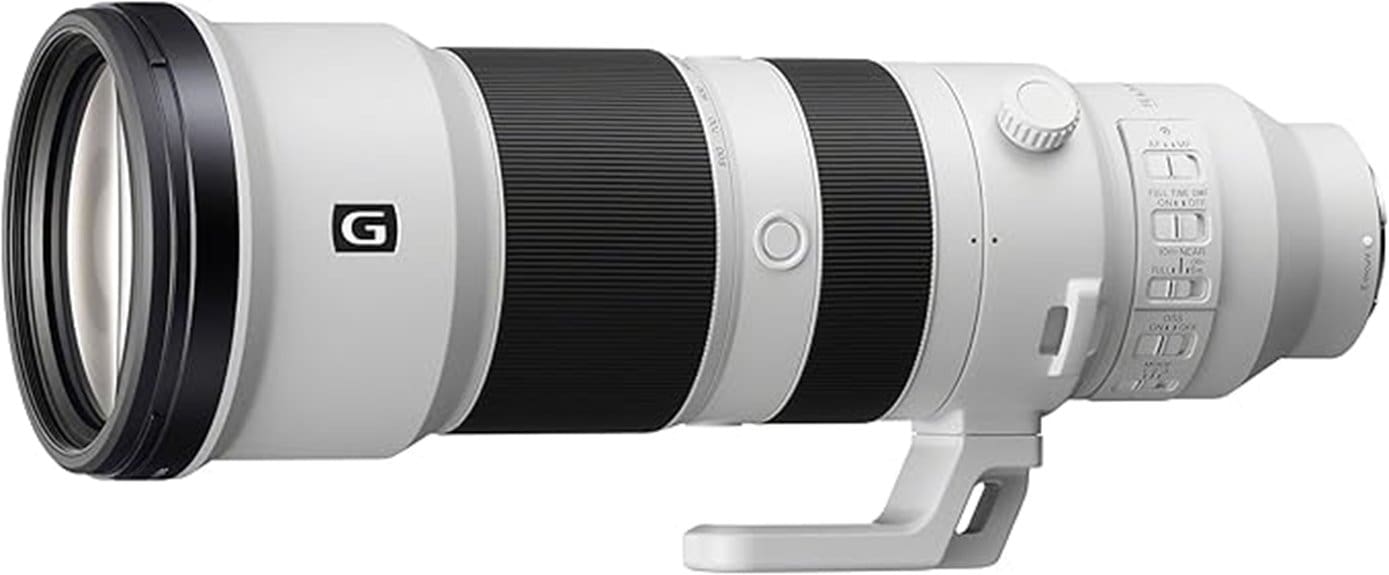

You’ll get a super‑telephoto that’s consistently sharp center‑to‑edge from 400–800mm with well‑controlled chromatic aberration and smooth bokeh. AF is tuned for quick subject acquisition and reliable long‑range tracking on compatible Sony bodies, while OSS and internal zoom stabilize framing and balance. At 2.475 kg it’s hefty but manageable on monopods or gimbals; 1.4× works, 2.0× is compromise. If you want performance details, specifications, and handling tips, keep going.
Some Key Takeaways
- Excellent central sharpness across 400–800mm with surprisingly strong edge performance for a super-telephoto zoom.
- AF and OSS deliver fast, reliable subject acquisition and stable long‑range tracking for wildlife and aircraft.
- Internal zoom and tripod collar provide neutral balance and predictable handling on monopods and gimbals.
- f/6.3–8 aperture limits low‑light capability; higher ISO or slower shutter speeds often required for handheld use.
- 1.4× TC is usable with modest resolution loss; 2.0× reduces contrast and AF reliability except on top bodies (A1).
Real‑World Image Quality: Sharpness, Bokeh, and Chromatic Aberration Across 400–800mm
While shooting with the Sony FE 400–800mm, you’ll notice consistently high central sharpness across the zoom range and strong edge performance for a super-telephoto zoom, thanks to its optical design and internal zooming that keeps the center of gravity stable. You’ll find frame-center resolution excellent from 400–800mm; edge sharpness is markedly better than typical zooms at these focal lengths, retaining fine detail toward the borders. Chromatic aberration is well controlled by element selection and coatings, yielding minimal fringing in high-contrast areas. Bokeh consistency is natural, with smooth out-of-focus rendering and restrained onion-ring artifacts across apertures. The lens pairs particularly well with sturdy tripods and gimbal heads to maximize stability and tracking with heavy super-telephoto setups tripod compatibility.
Autofocus, Stabilization, and Handling: AF Speed, OSS Effectiveness, Weight, and Ergonomics
Because Sony tuned the AF system for fast subject acquisition, you’ll find the SEL400800G locks onto subjects quickly and tracks reliably even at long focal lengths, with phase-detection AF on compatible bodies delivering consistent hits on moving wildlife and aircraft. You’ll appreciate the precise focus tracking, minimal hunting, and predictable micro-adjustment behavior across the zoom range. OSS reduces perceived shake effectively, enabling slower shutter use when perched or on monopods. At 2475 g the lens is heavy but manageable; its internal zoom and well-placed tripod collar yield a neutral balance feel. Controls are logical; ergonomics favor extended field use. This lens is well suited to enthusiasts who want dedicated camera accessories for wildlife and aviation photography.
Video and Shooting Logistics: 4K Video Use, Aperture Limits, Shutter Speeds, and Tripod/Handheld Workflows
Having established that AF and OSS keep subjects locked and shake down, you’ll want to ponder how the FE 400–800mm behaves for 4K capture and practical shooting setups. You’ll get clean 4K footage on compatible bodies, but the f/6.3–8 aperture range constrains exposure and low light performance, forcing higher ISO or slower shutter speeds. Use OSS and fast bodies to mitigate motion; expect minimal focus breathing but verify on your rig. For tripod work, the internal zoom and balanced weight aid panning. Handheld you’ll rely on OSS and high shutter speeds; clipped highlights and depth control are limited. Consider pairing the lens with travel tripods for steadier long-reach work and easier transport.
Compatibility and Expandability: Camera Body Compatibility, 1.4×/2.0× Teleconverter Results, and Filter Notes
If you pair the FE 400–800mm with one of Sony’s high-resolution or high-speed bodies (A1, A7 IV, A7R V, A7CR, FX3), you’ll get full benefit from its autofocus and OSS, preserving tracking performance and resolving power across the zoom range. You’ll find excellent camera compatibility for fast subjects; PDAF and lens stabilization remain effective. Teleconverter performance is solid with a 1.4×—modest resolution loss but usable AF—while 2.0× drops contrast and AF reliability on anything but the A1. The 105mm filter thread supports large glass or gelatin solutions; carry a drop-in or slim filter for minimal vignetting. This lens is an excellent match for photographers who prioritize mirrorless camera ergonomics and long-reach capability.
Who Should Buy It and Alternatives: Ideal User Profiles, Pros vs Cons, and Comparable Lenses
Now that you know how the FE 400–800mm performs on modern Sony bodies and with teleconverters, you can judge who will get the most from it. You should buy this if you prioritize reach, sharpness, and reliable AF for distant subjects—wildlife photographers who respect wildlife ethics and need long glass without huge cost will value it. Pros: compact for 400–800mm, OSS, teleconverter compatibility, high resolution. Cons: slow max aperture, heavy (2475 g), not weather-sealed. Alternatives: Canon RF 100-500mm with extender, Nikon Z 400mm prime, or Sony 200-600mm for better travel practicality and lighter handling. This lens is especially relevant for photographers focused on telephoto lenses who need long reach without the insane price of super-tele primes.
Some Questions Answered
Does the Lens Come With Registration or Software Benefits From Sony?
No — the lens itself doesn’t include automatic Sony registration or bundled software benefits; you’ll need to register it manually on Sony’s site to record warranty and ownership. You’ll still get Firmware updates support if Sony releases lens firmware; install via Sony’s recommended procedure or compatible camera body/software. You’ll also qualify for standard manufacturer warranty and any promotional offers only after you complete Sony registration and comply with seller return/warranty terms.
Can the Lens Be Serviced or Repaired at Third‑Party Shops?
Yes — you can have the lens serviced at authorized service centers or by independent repair shops, but there are trade‑offs. Authorized service preserves warranty, uses OEM parts, and follows Sony’s calibration/spec procedures. Independent repair may be faster or cheaper and can handle common fixes, but it risks voiding warranty and may use non‑OEM parts or different calibration standards. Evaluate cost, turnaround, and desired factory-level performance before choosing.
Are There Color or Finish Variations Besides Black?
No — the lens is only offered in black. You’ll note a matte vs gloss distinction isn’t officially provided; the finish is a standard matte black without glossy accents. You can pursue custom paint options, but that’ll void warranty and may affect weather sealing. If you need a different look, use skins or third‑party wraps to avoid service complications. Evaluate trade‑offs between appearance, resale, and protection before altering the lens.
What Is the Exact Weight Distribution for Gimbal Balancing?
You can’t get an exact weight distribution from Sony, but the lens’ center of mass sits rearward near the tripod foot位置, due to internal zoom and heavy mount. For gimbal balancing, you’ll need to shift the lens slightly back on the tripod plate and test for pitch/yaw neutrality. Evaluate by incremental adjustments: move the plate forward/back until the center of mass aligns under the gimbal pivot, then lock and fine-tune.
Are There Recommended Storage or Transportation Cases?
Yes — you should use both a hard case for shipping/air travel and a soft pouch for short moves and storage. The hard case protects against impact, crush, and moisture; choose one with foam cutouts sized to the lens (including hood). The soft pouch is lighter for quick transport and prevents dust/scratches in a camera bag. Always secure lens caps, remove tripod collars, and add silica gel for long-term storage.