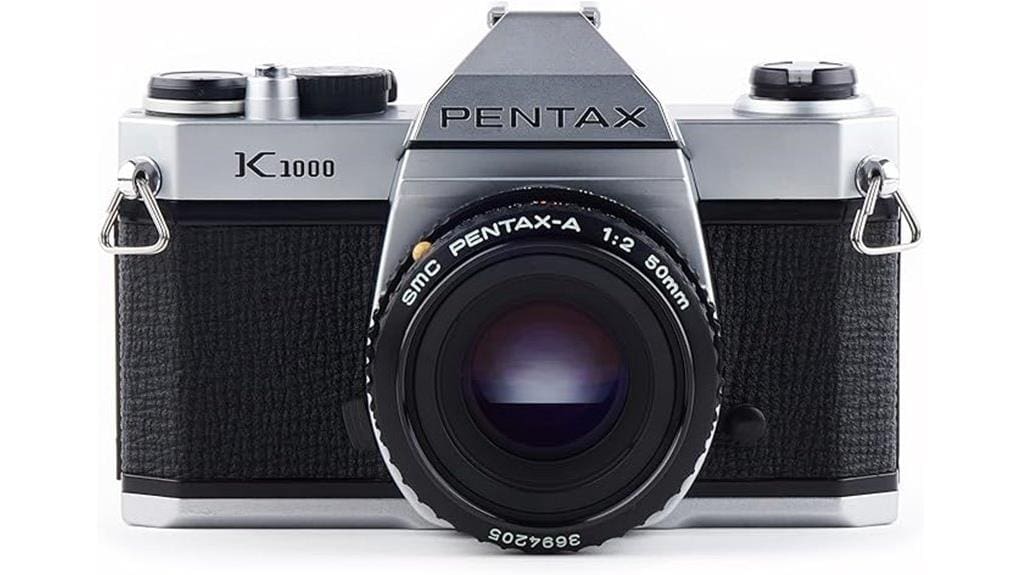

You’ll find the Pentax K1000 a no‑nonsense, all‑mechanical SLR that forces you to learn exposure, composition, and manual focus. Controls are tactile and predictable, the center‑weighted meter guides deliberate choices, and the K‑mount accepts many primes for practice. The 50mm f/2 is sharp centrally and produces pleasant though simple bokeh; build is nearly indestructible and it runs mechanically without a battery. It’s ideal for hands‑on learning—keep going and you’ll get practical checks, sample results, and buying tips.
Some Key Takeaways
- All‑mechanical K1000 emphasizes manual exposure, aperture, and focus for hands‑on film photography learning.
- Reliable center‑weighted meter with needle aids deliberate exposure but needs an LR44/A76 battery for metering.
- Crisp tactile controls and simple film loading make it durable and predictable for everyday use and teaching.
- Image quality with a 50mm f/2 prime is sharp in the center, improves stopped down, with smooth, simple bokeh.
- Limitations: no autofocus, no automation, basic meter misreads extreme scenes, and no built‑in flash or stabilization.
Why the Pentax K1000 Still Matters: Quick Verdict for Buyers
You’ll often find the Pentax K1000 recommended because it strips photography to its essentials: all-mechanical controls, a reliable built-in meter, and broad K‑mount lens compatibility, so you learn exposure and composition without automation getting in the way. You’ll appreciate its durable simplicity if you want affordable nostalgia that actually teaches. It’s a practical tool for film education—manual aperture, shutter, focus, and a meter that enforces deliberate choices. For a buyer seeking a rugged, low-tech platform to build skills, the K1000 delivers value: inexpensive to acquire, easy to maintain, and forgiving enough for repeated hands-on practice. The site Rediscover Analog offers a range of film camera gear and accessories that pair well with the K1000 for learners and enthusiasts, including lenses, film, and maintenance supplies for film camera gear.
What to Expect in Use: Controls, Metering, and Handling
Having a camera that teaches the basics naturally leads to questions about daily use—how the controls feel, how the meter guides exposure, and how the body handles in the field. You’ll work with tactile manual controls: shutter dial, aperture ring, and focus ring respond crisply, so you learn by doing. Viewfinder handling is direct—bright, 1.0x view with center-weighted meter indications that don’t intrude. Meter usage is straightforward: a needle shows over/under; set shutter or aperture to center it. Film loading is simple and reliable; the all-mechanical build gives predictable balance and reassuring heft during shooting. Its straightforward design makes it an ideal tool for those building fundamental skills in DSLR and film photography.
Image Performance With the 50MM F/2: Sharpness, Bokeh, and Exposure Results
Expect crisp, consistent results from the bundled 50mm f/2: it’s sharp in the center from wide open and tightens up markedly by f/4–f/5.6, while corners stay acceptable for a classic prime on 35mm film. You’ll notice a clean sharpness comparison against slower kit lenses—more microcontrast and fine detail. Bokeh character is smooth but simple, two-blade diaphragms creating slightly elliptical highlights; it’s pleasant for portraits but not dreamy. Exposure latitude of 35mm film paired with the K1000’s meter gives forgiving midtones; watch highlight rendering in high-contrast scenes, as bright areas can clip without careful metering. Telephoto lenses for wildlife and sports photography demand different handling and technique, particularly regarding telephoto reach and subject isolation.
Strengths and Limitations: Durability, Battery‑Free Operation, and What It Lacks
While the K1000’s all-mechanical build and simple controls make it nearly indestructible in everyday use, you’ll also appreciate that it doesn’t rely on electronics to take a picture—only a tiny LR44/A76 cell powers the always-on meter. You get clear mechanical reliability: shutter and advance work without battery, so you can shoot until film or light meter dies. That simplicity supports film nostalgia preservation and teaching fundamentals. Limits are obvious: no autofocus, no exposure automation, no built-in flash or stabilization, and a basic meter that can misread extreme scenes. It’s purposeful, not feature-packed. Many photographers pair the K1000 with sturdy protective gear like Pelican cases to safeguard their camera and lenses.
Buyers’ Guide: What to Check, What Accessories to Get, and Value for Money
Before you buy a K1000, check the shutter curtains, advance lever, and light-tightness of the body for worn seals or curtain pinholes—these are the most common wear issues on used units and directly affect image quality. Inspect the meter, film gate, and rewind knob; verify the lens aperture blades actuate cleanly. Get a fresh light-seal kit, spare LR44, and a reliable 50mm or wider K‑mount prime. Buy quality film storage sleeves and a hard case. Budget for processing and lab development, plus a decent handheld meter if you push ISO. Given durability and low repair costs, value is strong. Keep your camera sensor pristine by using proper sensor swabs and cleaning techniques to ensure consistently clean photos.
Some Questions Answered
Can I Shoot Long Exposures Without a Battery Installed?
Yes — you can shoot long exposures without the battery installed because the mechanical shutter operates independently; the camera’s mechanical shutter and manual controls let you choose slow speeds like Bulb. You’ll lose the light meter and must use external timing or estimation, so consider a cable release and tripod. Battery bypass isn’t needed to fire the shutter, but it’s required only to power the meter, so plan exposures manually and test timings beforehand.
Is the 50MM Lens Removable for Other Pentax Lenses?
Yes — the 50mm is removable; you can swap it for other K-mount lenses. You’ll work with an interchangeable mount that accepts a wide range of Pentax K lenses, vintage and modern. Remember lenses stay manual aperture on this body, so you’ll set aperture on the lens itself and control exposure manually. That hands-on approach gives you flexibility, but you won’t get electronic aperture control or autofocus.
Does the Camera Come With a Case or Strap Included?
No, it doesn’t include a case or strap. You’ll get the camera and the Pentax 50mm f/2 lens; battery for the meter is included, but camera accessories like a case or carrying options aren’t bundled. You’ll need to buy a strap, bag, or protective case separately based on how you plan to carry it. For hands-on use, choose a sturdy strap and a padded carry option to protect the all-mechanical body during travel.
Can I Use Modern Lithium Watch Batteries Instead of LR44?
Yes — you can use modern lithium watch batteries as a button cell alternative, but check battery chemistry and voltage differences first. Lithium cells (CR2032, etc.) deliver 3V versus LR44’s ~1.5V, so they’ll overdrive the light meter and risk damage or inaccurate readings. If you find a lithium labeled as 1.5V substitute, verify size and shelf life claims. Prefer genuine alkaline LR44 for proper operation and reliability.
Are Replacement Light Seals and Parts Readily Available?
Yes — light seal availability is good and parts compatibility is strong. You’ll find aftermarket light seal kits, foam, and shutters from hobby suppliers and vintage camera shops. Mechanical parts like wind levers, film spindles, and viewfinder components are commonly swapped or repaired; compatibility with K1000 parts is high. You should source from reputable sellers, inspect kits for fit, and be prepared to trim seals and test-fit parts during installation.